
A university machine-learning account holds a training dataset of unprotected personal data. No data findings appear, and DSPM was left off when the account was onboarded. What must be true before a data policy can see that dataset?
Select an answer to reveal the explanation.
Short Explanation
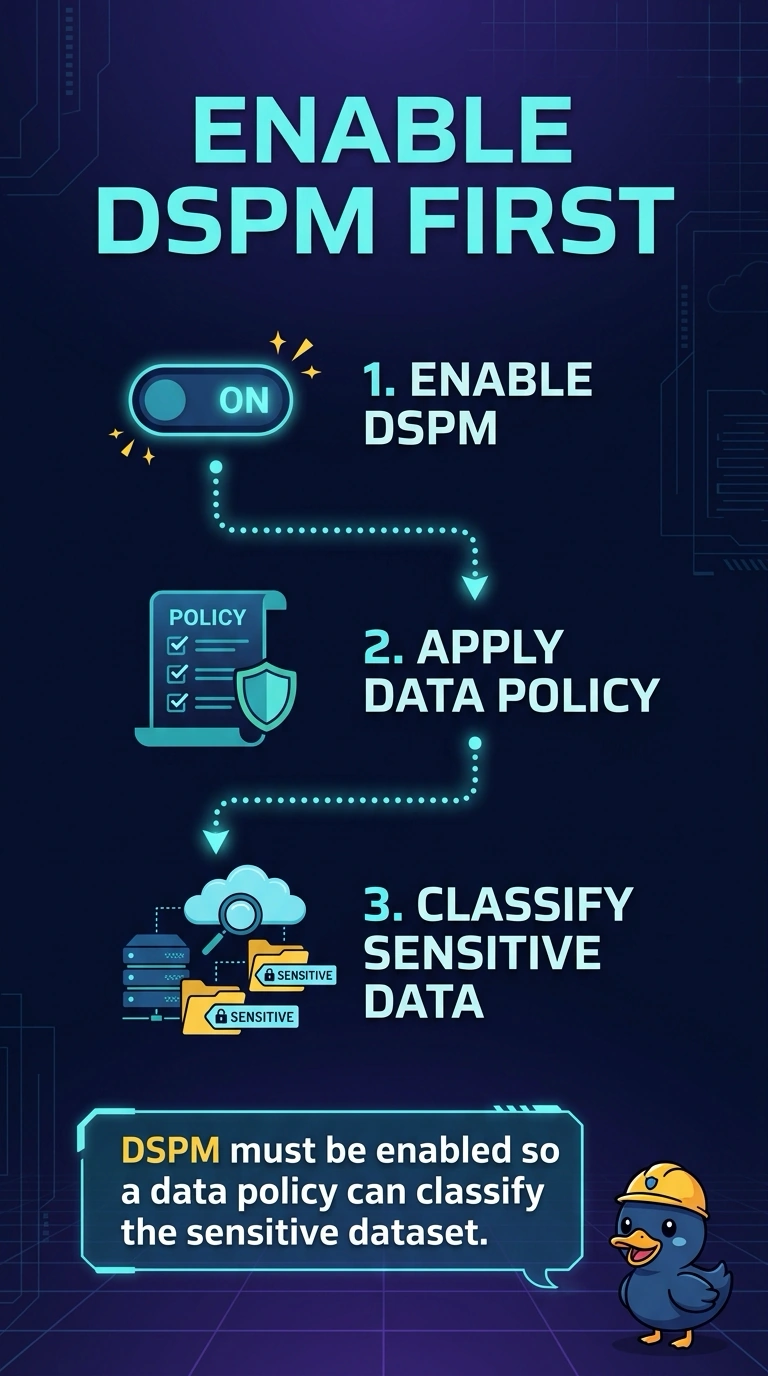
You can think of a data policy as a reader that needs DSPM switched on to see sensitive personal data in your training dataset. Since DSPM was left off, enabling it is what lets the policy classify the dataset; treating it as an over-privileged role, anonymous storage account, or attack path does not.
Full Explanation
A dataset containing personal data can appear as a data finding only when DSPM is enabled for the account. With DSPM left off, the data policy has nothing to match, so no data findings appear even though the unprotected personal data is present. Enabling DSPM allows the data policy to classify the sensitive dataset. An identity rule concerns an over-privileged role; treating the dataset as such misidentifies the issue and does not classify its contents. A network-exposure rule concerns marking the dataset as if it were an anonymous storage account. The scenario does not say that the dataset is exposed that way, and this rule would not identify the personal data. An attack-path policy requires a chain linking the dataset to a public security group. The scenario supplies no such chain, and inventing one would not address the missing DSPM setting. Exam caveat: the relevant classification profile, such as one for personal information, must also be enabled, or the patterns you care about may not be detected even after DSPM is on. Practical check: enable DSPM on the machine-learning account, enable the personal-data profile you expect, and confirm that the training dataset appears as a data finding.