
A customer-support vendor exposes a model endpoint that answers prompts with no authentication. The only rule in use is a generic virtual-machine hardening check. Which rule family matches this exposure?
Select an answer to reveal the explanation.
Short Explanation
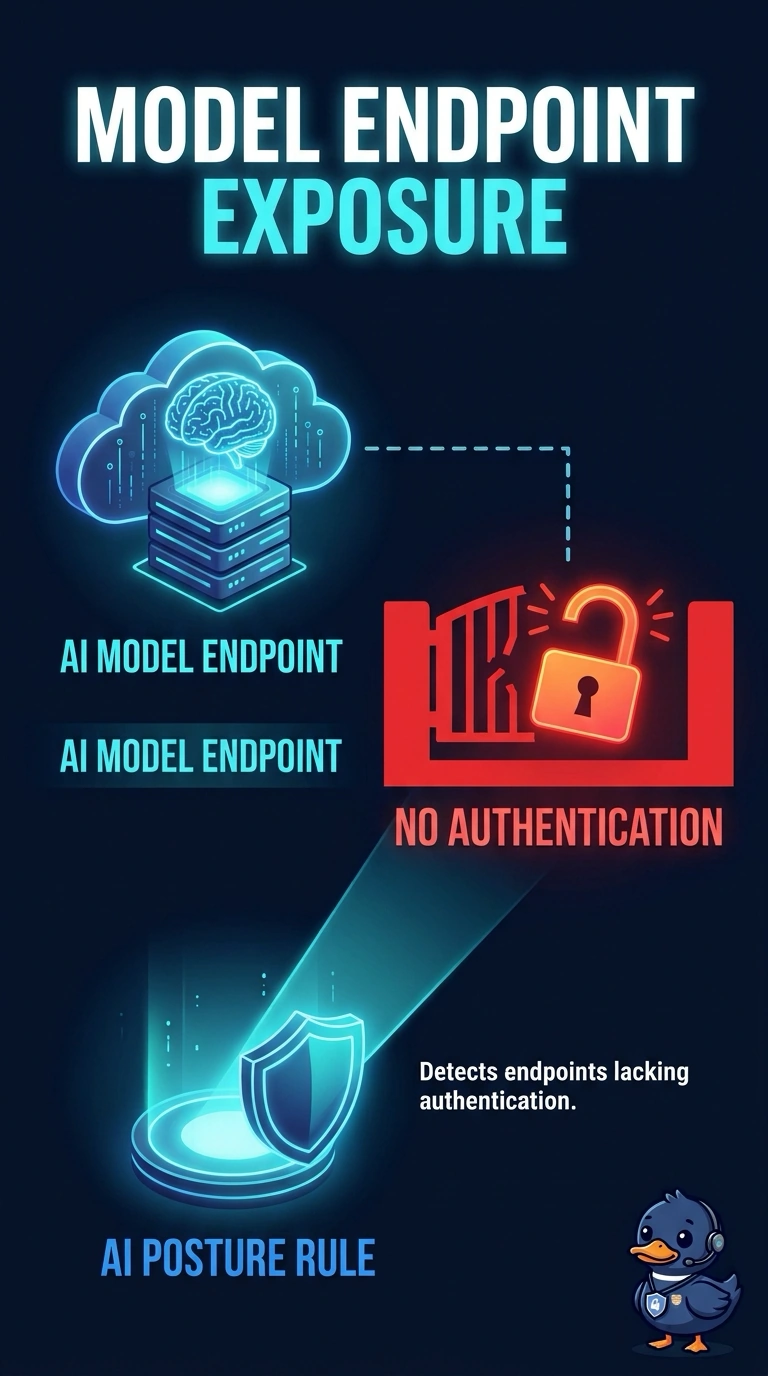
Think of an open model endpoint as a service window with no clerk, not as a loose screw on a virtual machine. You need the AI posture family for that unauthenticated endpoint. The trap is stretching a generic hardening rule until it pretends to cover the model.
Full Explanation
AI posture is its own rule family, separate from configuration, identity, network exposure, data, and attack path. A model endpoint that answers with no authentication is an AI posture finding, not a generic virtual-machine hardening result. The hardening check can still be useful for the VM and will not describe this endpoint. A trusted-image rule allows a golden registry and flags other images. It is a workload outcome about image trust, not about whether a model requires authentication. A repository license rule flags a disallowed license in code. Packages pulled into the service might have license issues, and that scan does not see the live unauthenticated endpoint. A Broker VM does not classify Office 365. SaaS DSPM for Office 365 is a cloud-scan data source, and PHI classification is a data profile, not an applet on the broker and not an AI posture rule. Exam caveat: network exposure, missing authentication, and weak encryption can also be described on API gateway integrations. This model endpoint is still filed as AI posture rather than as a VM benchmark. Operational check: confirm an AI posture rule is evaluating the endpoint and that the only hit is not a virtual-machine hardening finding with the model missing from that queue.