
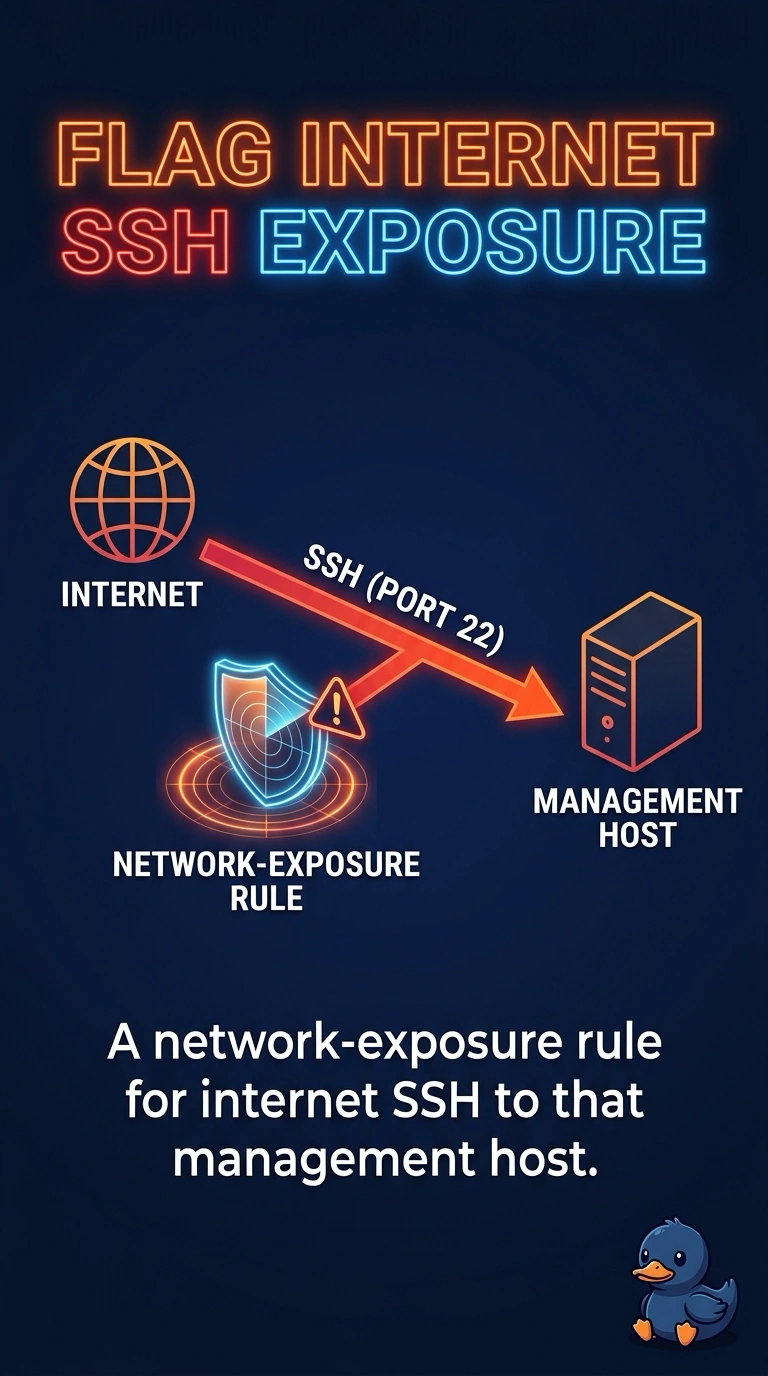
A security group at an electric cooperative allows SSH from the internet to a management host. Which rule family should flag that exposure?
Select an answer to reveal the explanation.
Short Explanation
Think of internet SSH as a side door propped open on the street, not as a password written on a sticky note. You flag that security group with a network-exposure rule. The trap is sending it to secret scanning because administrators use keys to log in.
Full Explanation
A security group that allows SSH from the internet to a management host is network exposure. The rule family that should flag it is a network-exposure rule, not a secret scan and not a malware indicator. A repository secret rule looks for secrets in code, such as a private key committed in git. Operators may use keys to connect, and the finding in the question is the open path, which remains even after every key is rotated. A data rule that requires the PHI profile classifies health data in stores. The cooperative's management host is not that data finding, and PHI is the wrong profile unless the store actually holds health data. An indicator of compromise matches a known hash, address, domain, or path on endpoint data. It does not evaluate a cloud security group, and a malware hash on an endpoint is a different event from an internet-exposed management port. Exam caveat: if that exposed host also has an over-privileged role, the chain can be an attack path beside the exposure. The exposure finding still stands on its own. Operational check: confirm the cooperative's network-exposure policy shows this security group and that the result is not waiting in a secret-scanning or indicator queue.