
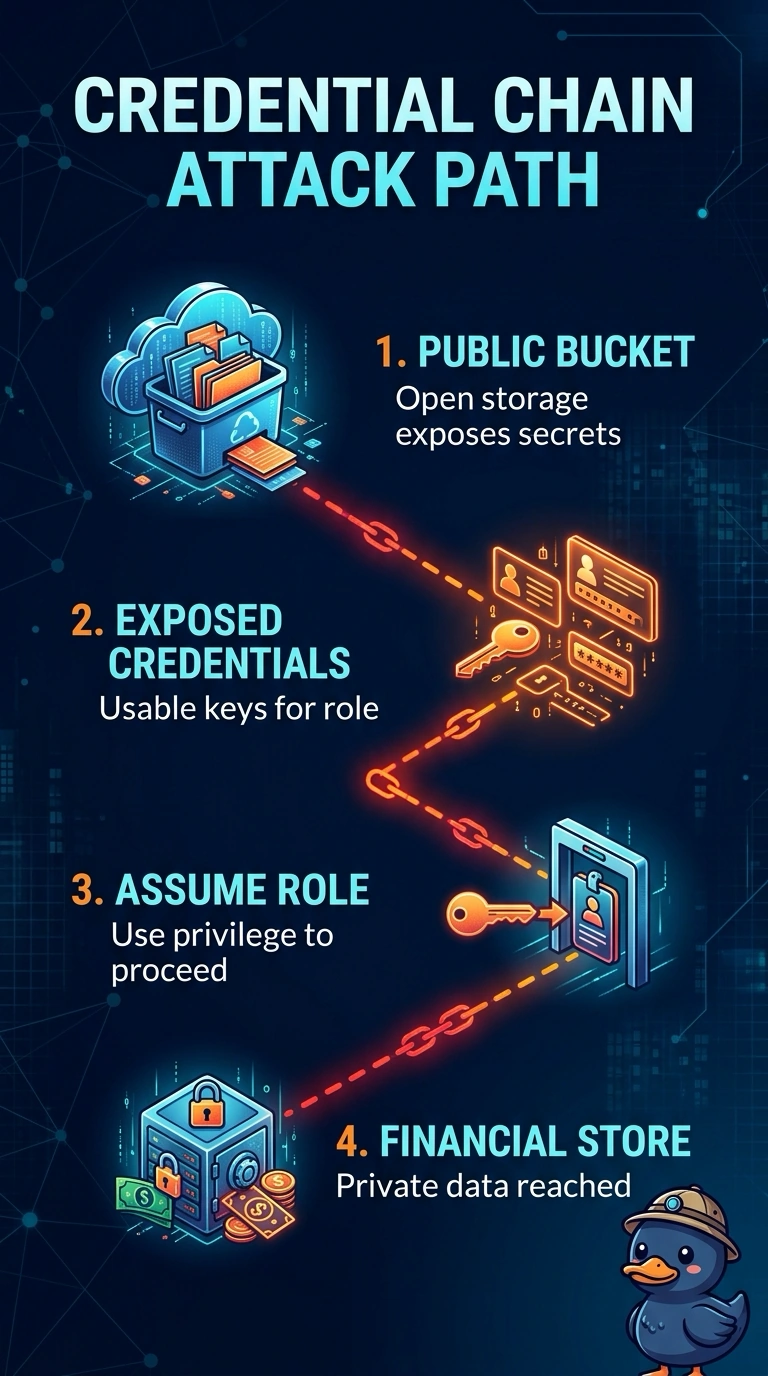
A public bucket exposes usable credentials for an overprivileged role that can read a private financial store; leadership wants the exploitable chain rather than the open bucket alone. Which result is that?
Select an answer to reveal the explanation.
Short Explanation
Public storage and an unrelated role permission do not by themselves establish a traversable attack path. Here exposed usable credentials connect the entry point to the privileged identity and target; you can see the attack-path finding describes that chain. A bucket-only exposure result, object malware verdict or module-license finding does not describe it.
Full Explanation
Public storage and an unrelated role permission do not by themselves establish a traversable attack path. Here exposed usable credentials connect the entry point to the privileged identity and target; the attack-path finding describes that chain. A bucket-only exposure result, object malware verdict or module-license finding does not describe it. The key result is correct because it links public credential exposure to role use and access to the private financial store as one exploitable sequence, showing how an actor can move from publicly reachable data to privileged access. A network-exposure finding that mentions the public bucket while ignoring role use remains a single-resource posture issue and does not model credential reuse or lateral movement to the financial store. A malware verdict recorded against objects in the bucket addresses file content safety, not identity traversal, and provides no connection between credentials, role assumption, and target access. A license finding on the infrastructure module that created the bucket addresses governance of code, not runtime exploitability, so it cannot represent the credential-to-role-to-store chain.