
A bank baseline requires production storage to block public access. Both the live account and its corresponding Terraform currently allow public access. Which control flags the live baseline violation?
Select an answer to reveal the explanation.
Short Explanation
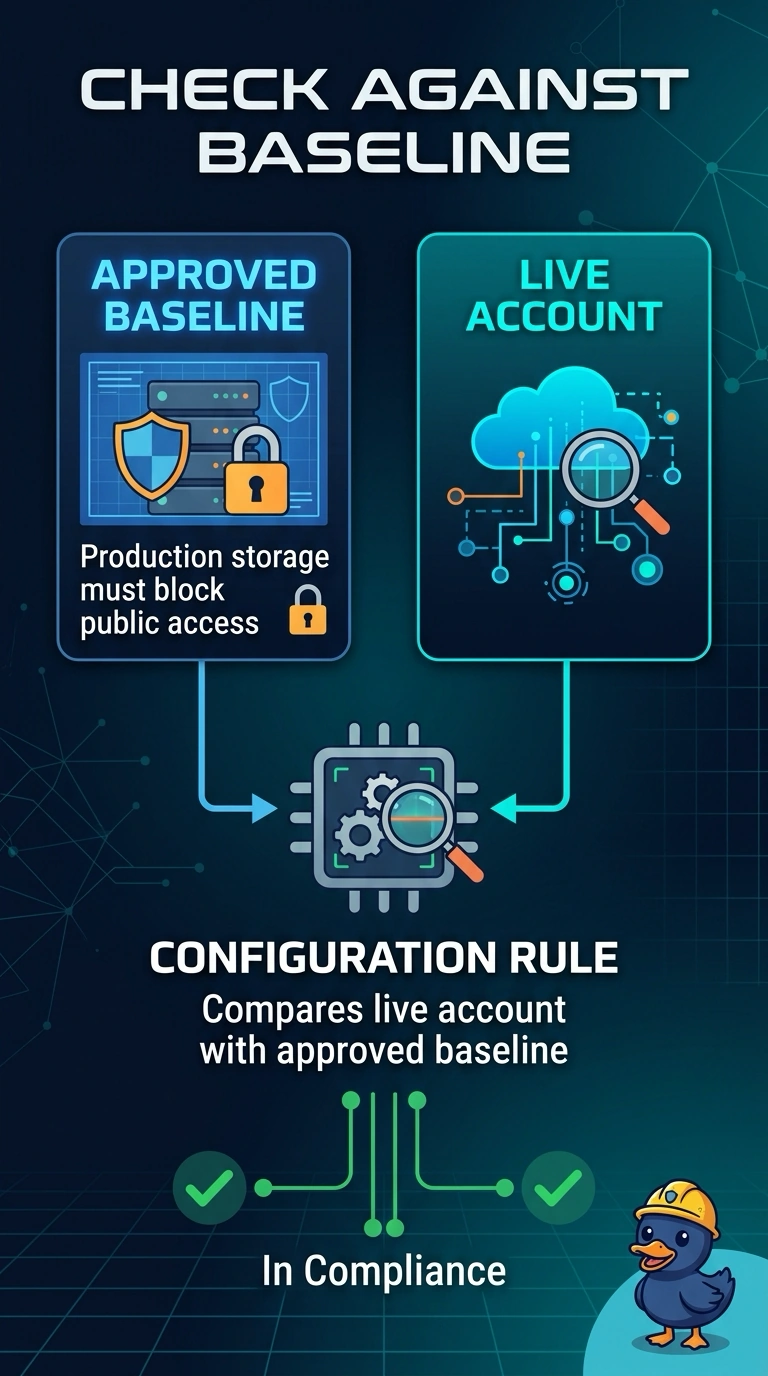
Picture you checking the live storage against the bank baseline, even though the Terraform agrees with the insecure live setting. You need a configuration rule to flag that baseline violation. There is no drift discrepancy for you to catch because code and runtime match.
Full Explanation
A configuration rule is the correct control because it evaluates the live storage account against the approved baseline requiring blocked public access. Even when Terraform allows public access, the live violation still exists and CSPM configuration evaluation flags it as non-compliant. IaC drift compares desired code with actual runtime state and flags security-rule discrepancies. Here code and runtime agree on the insecure setting, so CSPM configuration evaluation catches it without a drift discrepancy. A software composition finding reports a vulnerable direct or transitive library in the storage module and does not assess the public-access setting. An attack-path rule correlates several findings into one exploitable chain, while this scenario describes a single baseline violation rather than a chain. Exam caveat: distinguish baseline non-compliance from lack of drift, since matching insecure code and runtime still violates the baseline. Practical check: inspect the live public-access setting, confirm the baseline requirement, and review the corresponding Terraform to confirm it also permits access.