
A public library's storage account allows anonymous access from the internet. Which rule family should catch that exposure?
Select an answer to reveal the explanation.
Short Explanation
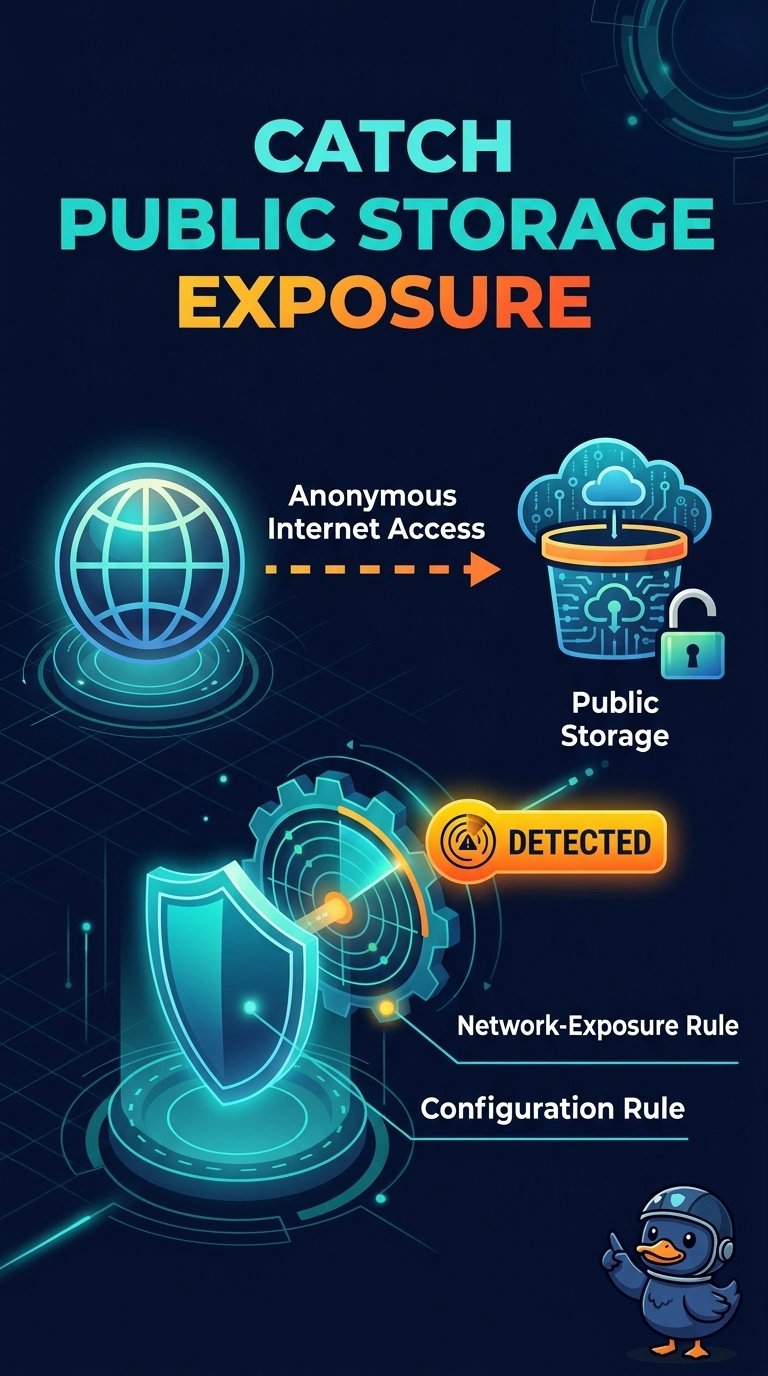
Think of anonymous access as a door left open to the internet, not as an over-privileged role, malware, or a secret in code. You classify the public storage account under network exposure or configuration. The key is to match the rule family to the account’s live exposure, even when identity also seems relevant.
Full Explanation
A public storage account with anonymous access from the internet is a network-exposure or configuration finding, so that rule family should catch the exposure. The finding concerns the account’s live setting and reachability, not a different kind of risk. An identity rule aimed at a role that holds far too much privilege addresses excessive permissions assigned to an identity; it does not describe the storage account’s anonymous setting, even though both concerns relate to access. A malware result from an agentless disk scan of an unrelated container image concerns malware detected in that image. It neither describes the storage account nor explains its public access. A repository secret scan aimed at the module that created the account looks for exposed secrets in code. The module may have created the account, but the question asks about the account’s current anonymous access, not a secret in the repository. Exam caveat: a far-too-privileged role could also have access to the public account, but that identity concern would be distinct from the account’s network exposure. Practical check: verify that the applicable network-exposure or configuration policy is enabled and that the anonymous account appears in its findings, rather than relying only on identity, malware, or repository-secret results.