
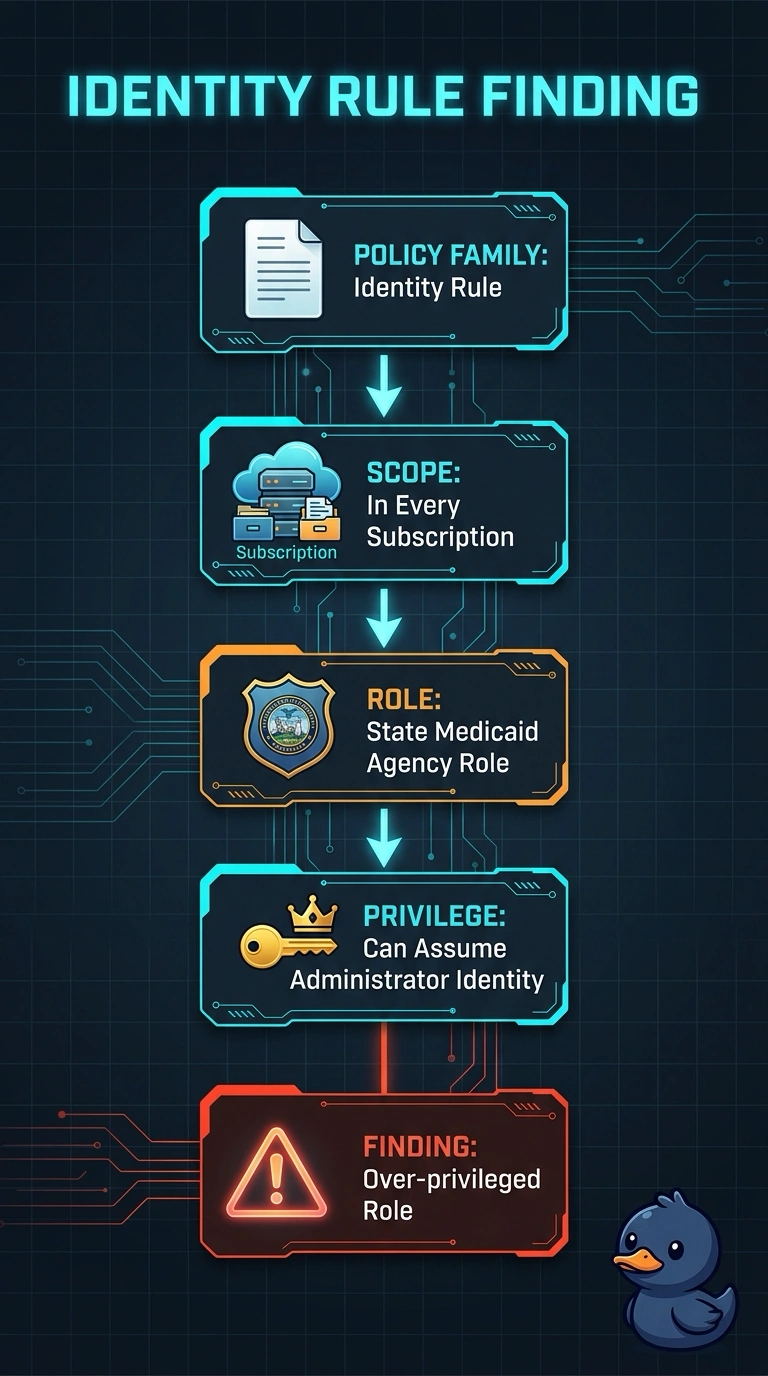
A role in a state Medicaid agency can assume an administrator identity in every subscription. Which policy family should raise that finding?
Select an answer to reveal the explanation.
Short Explanation
Think of a master key that opens every building: the problem is with the key, not malware on a container image. You have a role that can assume an administrator identity across every subscription, so this is an identity finding—not a malware, card-number, or trusted-image finding.
Full Explanation
An over-privileged identity is an identity finding. A role that can assume an administrator identity in every subscription is that case, so an identity rule for the role is the policy family that should raise it. A Cloud Workload malware rule evaluated against container images looks for malware, not for the role’s ability to assume administrator privileges, and will not describe this identity. A data rule that looks for card numbers inside object storage accounts catches sensitive data; DSPM and classification are needed before those findings exist. Card numbers in storage are not an assume-administrator path. A trusted-image rule allows the agency’s golden registry and flags other images. That is a workload finding about where an image came from, not about an IAM role. Exam caveat: if the role can also read a public bucket, that adds a separate exposure to consider, but it does not replace the identity finding on the role itself. Operational check: confirm the Medicaid identity policy flags this role and that the result is not sitting in a malware or trusted-image queue.