
A retailer already maintains one dynamic asset group for production machines. Those same machines need both a vulnerability policy and a Cloud Workload policy. How should the two policies be scoped?
Select an answer to reveal the explanation.
Short Explanation
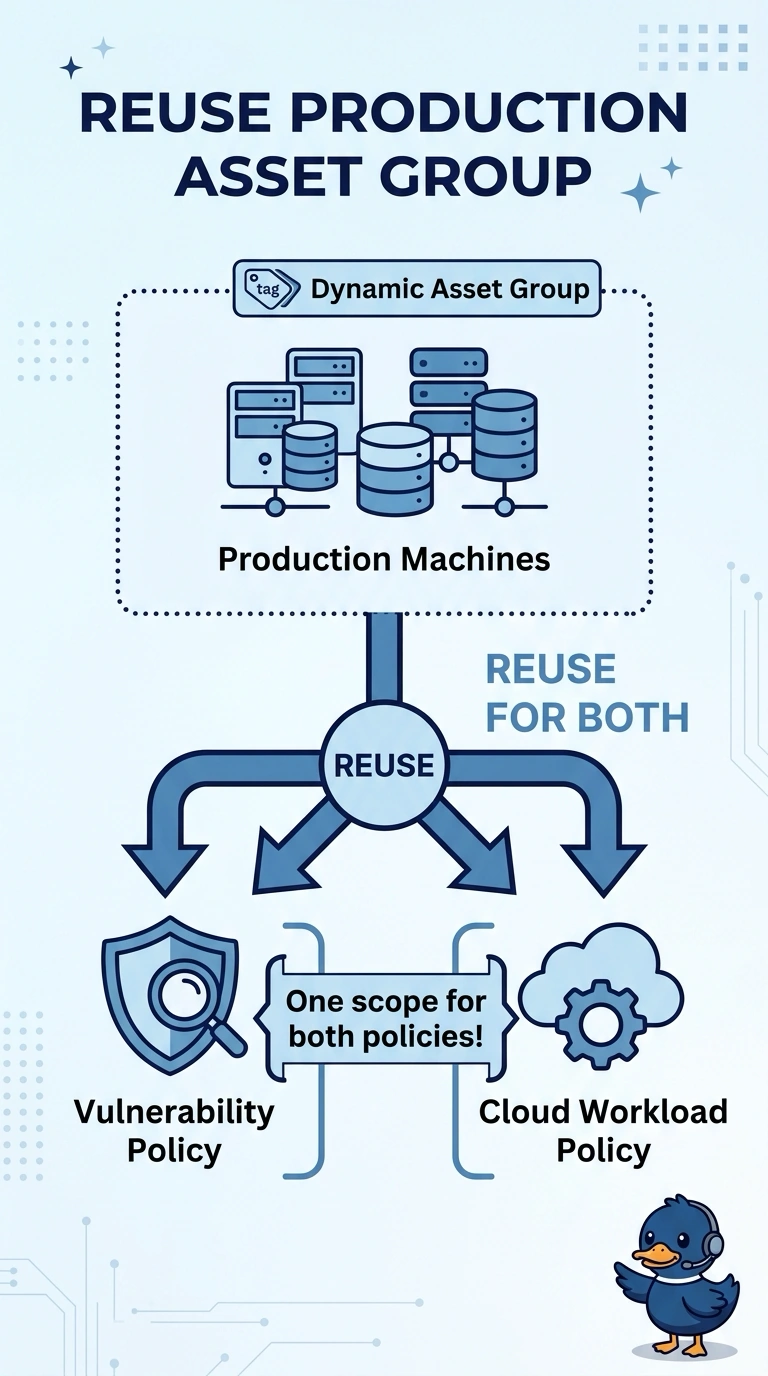
Think of the production group as one key that should open two locks, not two keys cut from a fading photocopy. You already have a dynamic group for those machines, and both the vulnerability policy and the workload policy can use it. The trap is cloning a private list per policy and then watching the copies drift.
Full Explanation
Vulnerability policy scope is an asset group, and a Cloud Workload policy runs its rules against the assets in scope the same way. One dynamic production group can be reused on both policies so a new production machine that matches the filter is covered by both without a second list. A static clone of host names is a hand-picked snapshot. The next autoscaled instance joins the dynamic group and misses every cloned list, which is the drift a shared group avoids. SBAC decides which assets a person may see, using a dynamic group as the scope. It is not how you attach a policy to machines, and a role per author does not define policy scope. A compliance standard is an assessment and a report. Turning a group into a standard, or pointing a policy at a PDF, does not make the vulnerability or workload policy evaluate those hosts. Exam caveat: the same group can also be used for exclusions or enrichment, and those uses stay distinct even when the membership is shared. Operational check: confirm both policies name the production group, add a test tag that should match, and verify the new asset is in that one group rather than in a copied list.