
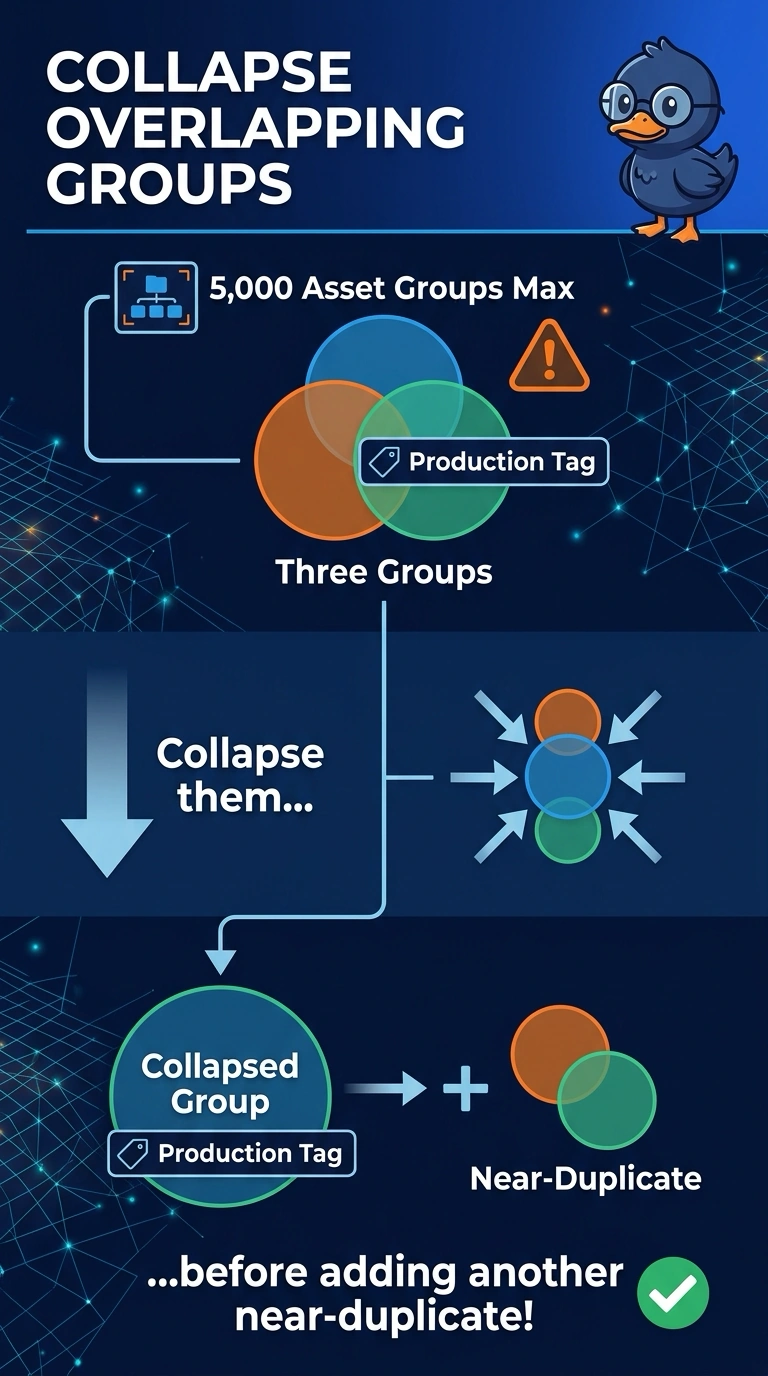
A media company is close to the platform ceiling of 5000 asset groups. Someone asks for another group that matches the same production tag as three groups already in the tenant. What should happen first?
Select an answer to reveal the explanation.
Short Explanation
Think of asset groups as shelves in a stockroom that only holds 5000 of them. You are about to build a fourth shelf for the same production tag, and the useful move is to collapse the overlaps first. The trap is inventing a higher ceiling or freezing every group into a static list.
Full Explanation
The platform limit is 5000 asset groups, and filters should stay short. Three groups that already match the same production tag are near-duplicates. Collapsing them frees room under the ceiling and leaves one dynamic filter that still picks up future production assets. Splitting the tenant across regions does not raise that ceiling. Region is a scope attribute, not a way to multiply the group limit. Converting every dynamic group into a static list would freeze membership. New production assets would stop joining until someone edits each list, and the conversion does not remove the near-duplicates that caused the request. Dropping asset groups and scoping every policy to the whole tenant throws away the production boundary the policies were using. Vulnerability policies, workload policies, and scope-based access all depend on groups used the right way. Exam caveat: a static group cannot be an access scope, so converting the production group to static would also break SBAC if that group was the scope. Operational check: count groups against the 5000 ceiling, merge the three production-tag groups into one short filter, and point the policies at that single group.