
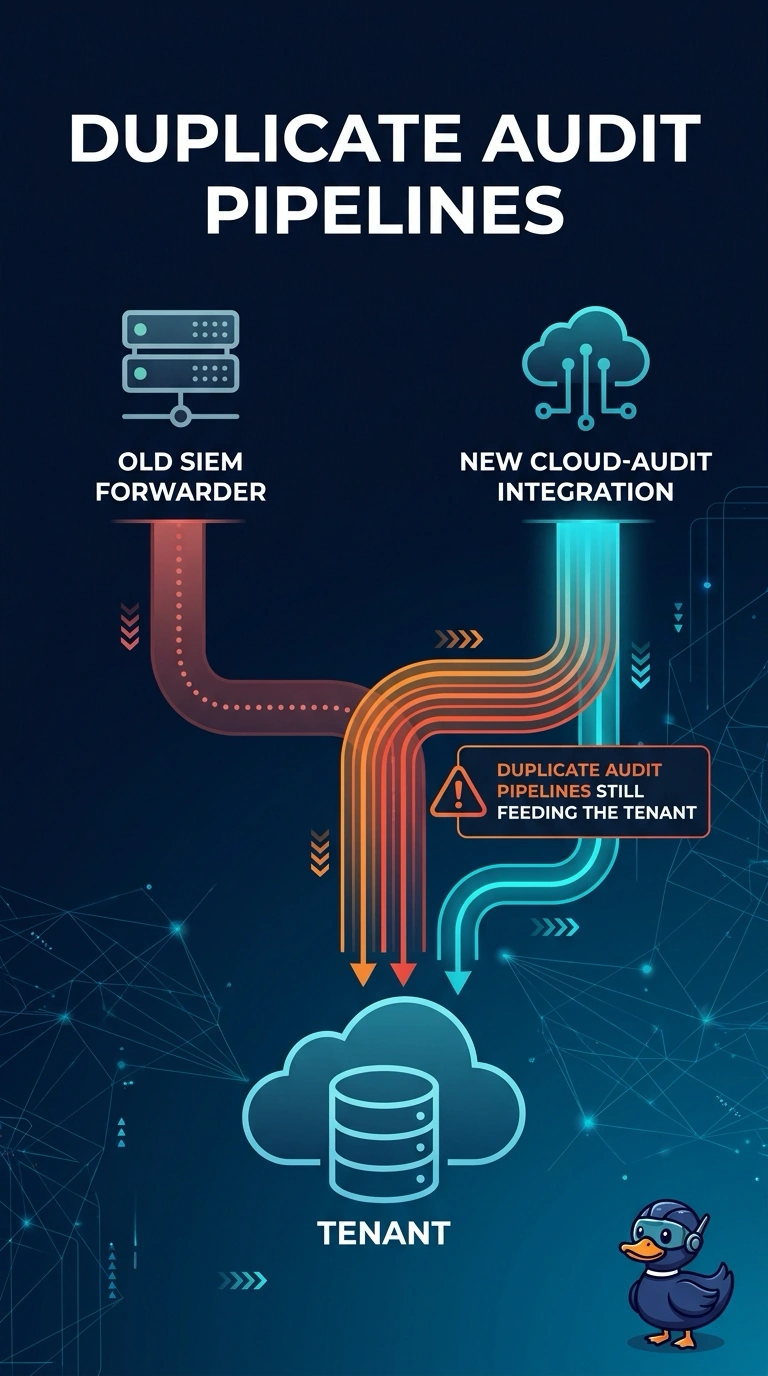
During a move into Cortex, both the old SIEM forwarder and the new cloud-audit integration stay enabled. Ingestion cost rises and no new account was added. What is the cost lever?
Select an answer to reveal the explanation.
Short Explanation
You’re paying two delivery services to bring the same package, even though you haven’t ordered more goods. With the old SIEM forwarder and new cloud-audit integration both enabled, the duplicate pipeline is driving ingestion cost. Scanner instances in each application account are a tempting distraction for a cloud-scan design that shouldn’t put a fleet on your bill.
Full Explanation
Duplicate audit-log pipelines raise ingestion cost without adding coverage. The old SIEM forwarder and new cloud-audit integration are both still delivering, and no account was added, so disabling one of those feeds is the cost lever. A missing time-synchronization path using UDP 123 to time.google.com and pool.ntp.org can cause clock skew, but it does not double audit ingestion. The platform allows up to 5000 asset groups; being under that ceiling, or having too few groups, does not create an ingestion charge. Cloud-scan compute is mostly Palo Alto Networks’ bill, so scanner instances in each application account are not the explanation for this ingestion rise: a cloud-scan tenant should not show a scanner fleet on the customer bill. Exam caveat: Actual outpost compute, storage, and egress can incur customer charges; unused quota is a limit, not a charged capacity reservation. Practical check: List the audit sources still attached, disable the leftover SIEM forwarder or extra trail, and confirm ingestion drops while every in-scope account retains one feed.