
A platform team disables DSPM to cut cost and leaves agentless disk scanning on a short cadence with measured repeated snapshot scans of unchanged VM disks in a customer-owned outpost. The scan bill barely drops. What cost is still running?
Select an answer to reveal the explanation.
Short Explanation
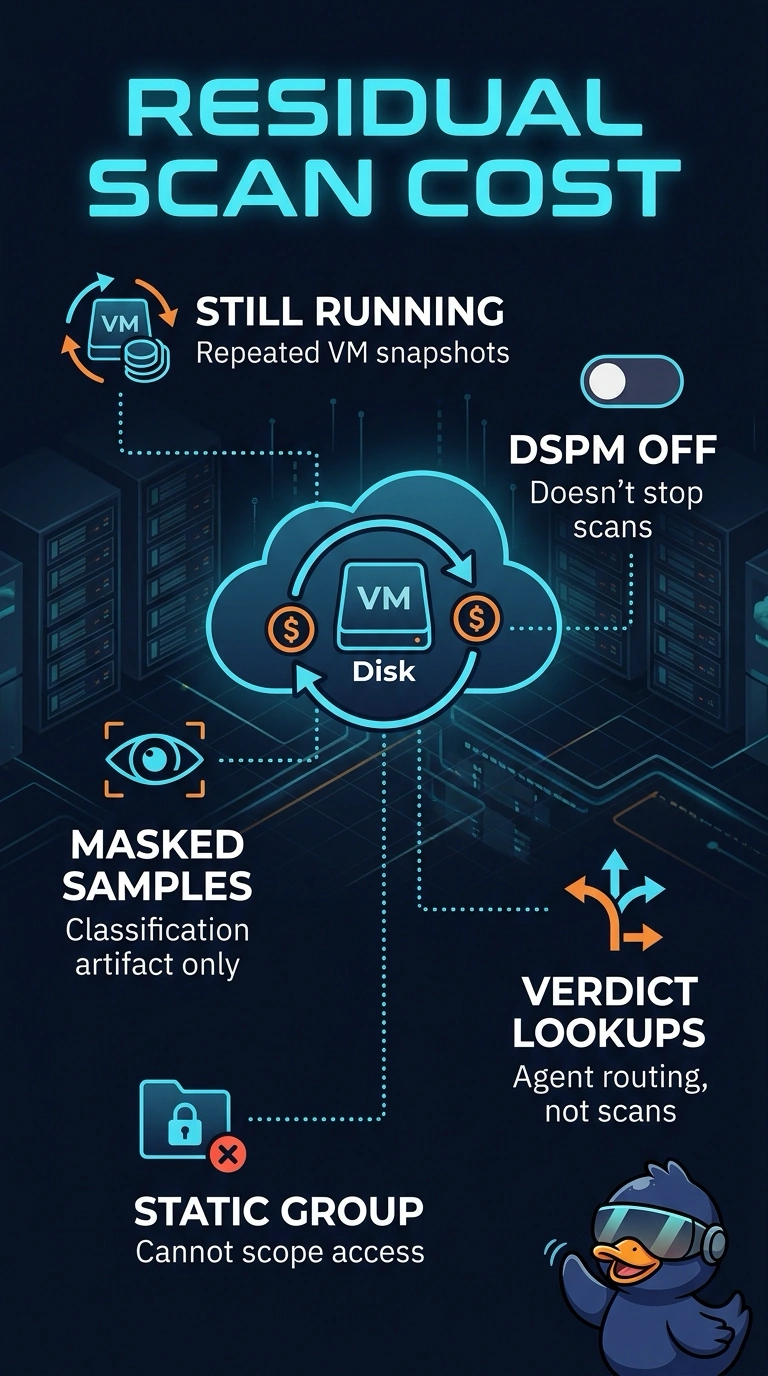
You turned off DSPM but you left the scanner running. You still have measured repeated snapshot scans of unchanged VM disks in a customer-owned outpost, so that cadence is the cost that remains. Don't chase PHI samples or verdict routing while that schedule is still busy.
Full Explanation
A short agentless disk cadence that repeats snapshot scans without new changes raises cost without new coverage. DSPM was turned off, and the bill barely moved, because measured repeated snapshot scans of unchanged VM disks in a customer-owned outpost are still running. That residual scan activity is the cost to address with supported scan settings, not DSPM. Masked samples are three masked examples per pattern per object when Collect Masked Patterns is on. They are a classification artifact for review, not the disk-scan schedule, and disabling DSPM does not leave them running as a scanner fleet. Verdict lookups sent to the region nearest the endpoint are part of agent operation. They are not agentless snapshot scans of VM disks and do not explain snapshot and scanner compute. A static asset group cannot serve as an access scope. Attaching one does not launch scanners and does not create scan charges. Exam caveat: in an outpost, this cadence is customer-paid compute. On cloud scan, most scanner compute sits with Palo Alto Networks, so confirm the mode before you describe whose bill moved. Operational check: Inspect scan execution and actual snapshot/compute charges, then use the supported scan settings to reduce unnecessary coverage while preserving requirements. A longer interval does not itself prove deduplication or that unchanged disks are skipped.