
A fintech workshop treats how long cloud audit logs are kept and how often container images are scanned as one setting. Which statement keeps those two planning targets separate?
Select an answer to reveal the explanation.
Short Explanation
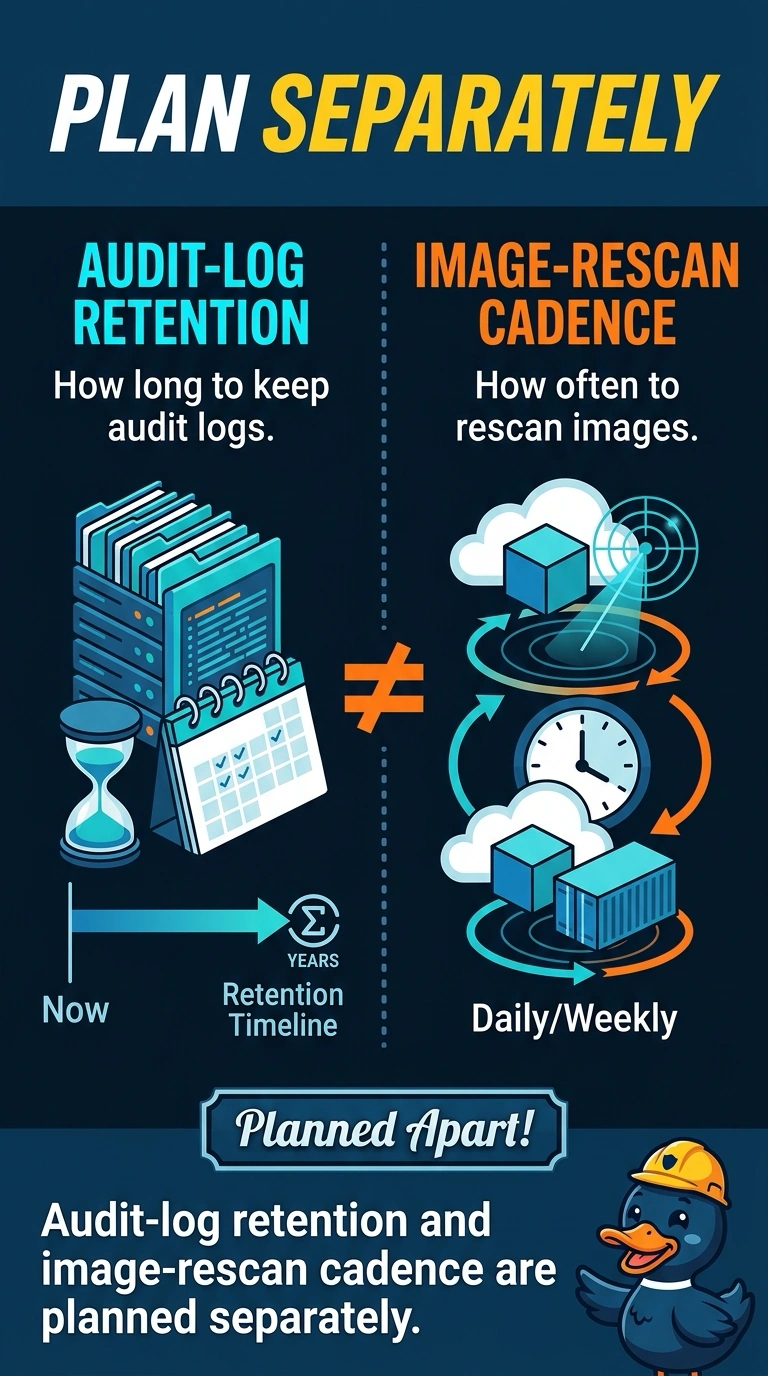
Think of the log archive and image scanner as two clocks on the same wall: you can adjust one without touching the other. Retention does not decide how often images are scanned, so keep these separate cost and coverage choices.
Full Explanation
Plan image-scan cadence and audit-log retention as separate targets. Unnecessary external full-scan invocations can consume resources, but native registry scanning deduplicates immutable images and reevaluates vulnerability metadata without rereading layers; engine updates or failed scans can justify a rescan. Duplicate audit-log pipelines, meanwhile, raise ingestion cost independently. Changing how long you keep audit logs does not set how often images are scanned, and slowing image scans does not define your audit-log plan. One scan cadence cannot both retain audit logs and rescan every unchanged image: these are different pipelines with different bills. Outpost image egress is a real customer cost, but it is not the only cost lever. Cloud-scan compute stays mostly on the Palo Alto Networks bill; outpost compute, quotas, and image egress stay on the customer bill. Those costs do not make retention and cadence the same decision. Changing audit-log keep time should not make cloud-scan compute appear as a new scanner fleet on the customer bill; that expectation confuses who pays for cloud scans with an audit-log planning choice. Exam caveat: a duplicate audit trail can raise ingestion cost even when image-scan cadence is unchanged, so a quiet scanner fleet does not prove the audit pipeline is cheap. Practical check: write the two targets on separate lines, name who pays for scan compute in your tenant, and confirm that a cadence change is not being used as the audit-log retention plan.