
A United States tenant has a laptop in Singapore. Verdict lookups are slow because the firewall allows only the United States verdict destination. Where should those verdict requests be allowed to go?
Select an answer to reveal the explanation.
Short Explanation
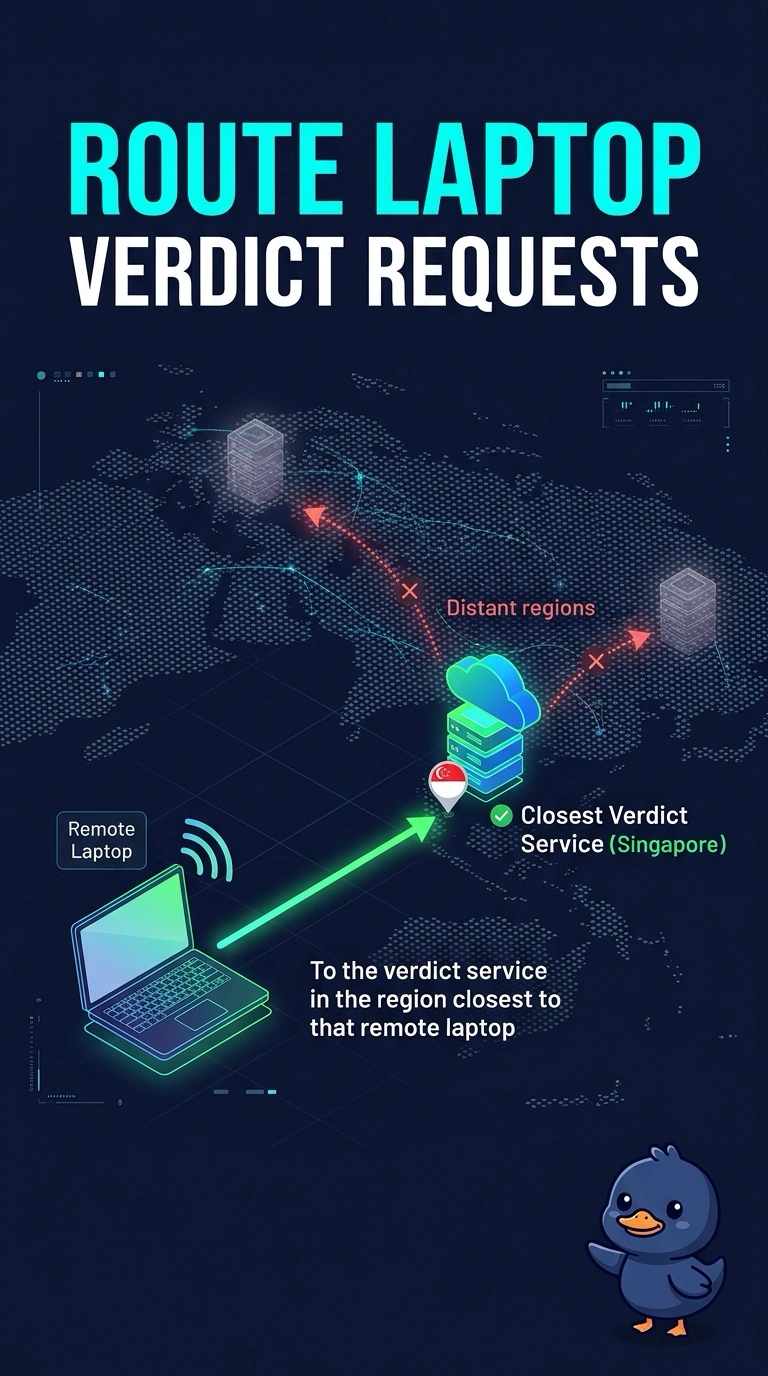
Think of a verdict as asking the nearest clerk, not mailing every question back to headquarters. Your tenant can sit in the United States while this laptop is in Singapore. Verdict requests go to the region closest to the endpoint, so a firewall that allows only the tenant-region address makes that lookup take the long way.
Full Explanation
Verdict requests go to the region closest to the endpoint, not necessarily the tenant region. Indicators and verdicts are separate from heartbeat and upload. This laptop should be allowed to reach the verdict service in the region closest to Singapore even though the tenant itself is in the United States. Allowing only the tenant region forces the long path and matches the slow lookups. The heartbeat host in the tenant region is the ch- name used for heartbeat, not the verdict service. Opening only that host does not fix verdict routing, and it still ignores the nearest region. Provide a working approved time source; time.google.com and pool.ntp.org are documented Broker VM defaults, not mandatory time servers for every laptop. They do not carry verdicts for remote laptops. Exam caveat: after verdicts are allowed to the nearest region, heartbeat and EDR upload still use the tenant regional ch- and dc- names on outbound TCP 443. Fixing verdicts does not replace those allows. Operational check: from the Singapore laptop network, allow the nearest-region verdict destination, then compare lookup time with a laptop that was pinned to the United States address only.