
A regional credit union has no rule that scan data must stay in its own accounts, and it does not want to operate scanner fleets. Which scan mode fits that constraint?
Select an answer to reveal the explanation.
Short Explanation
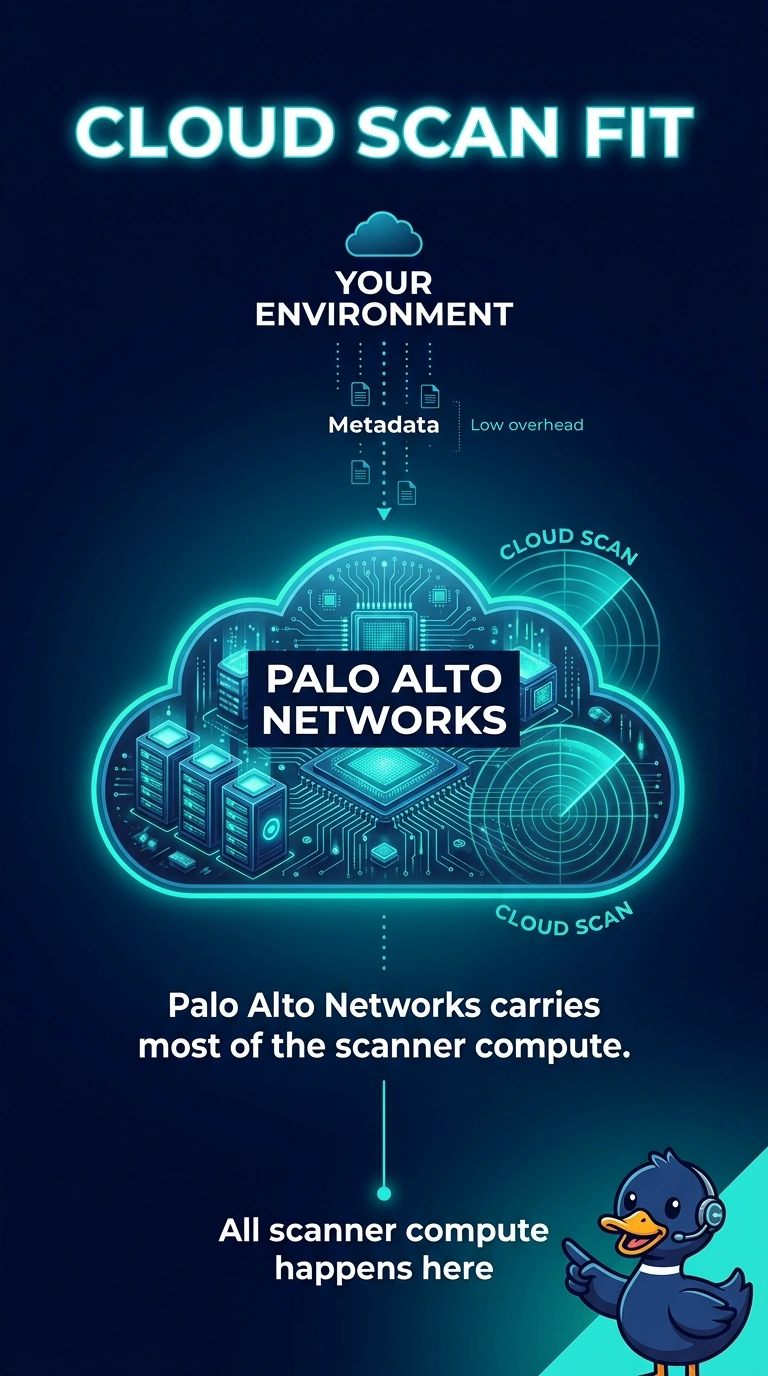
Think of cloud scan as hiring the scanning crew instead of building your own workshop. You have no residency rule that forces scanners into the credit union's accounts, so cloud scan fits, and Palo Alto Networks carries most of that compute. The trap is standing up an outpost and then paying for a fleet you did not need.
Full Explanation
Cloud scan is the recommended default. Palo Alto Networks runs the scanners and bears most of that compute. A credit union with no data-residency rule and no wish to run scanner fleets is the case cloud scan is for. An outpost is for residency or a boundary the customer must own. Outpost compute, quotas, and image egress land on the customer bill, inside a dedicated account, which is the opposite of this constraint. A Broker VM bridges a customer network. It does not select scan mode, and cloud scan can see AWS, Azure, GCP, and OCI accounts that are onboarded. Claiming cloud scan cannot see AWS is the wrong objection. OCI, Alibaba Cloud, and IBM Cloud support managed cloud scan only. Naming OCI does not describe an AWS-only estate and does not change the mode decision for AWS. Exam caveat: cloud-scan DSPM can see customer data inside Palo Alto Networks accounts and deletes it after the scan. A later rule that forbids that read would force an outpost redesign even though compute stayed off the customer bill. Operational check: confirm the credit union environments are set to cloud scan and that the cloud bill does not grow a scanner fleet after onboarding.