
A manufacturer's SOC already investigates detections in this Cortex tenant. Cloud coverage planning is just starting. What should the plan decide before anyone stands up another product out of habit?
Select an answer to reveal the explanation.
Short Explanation
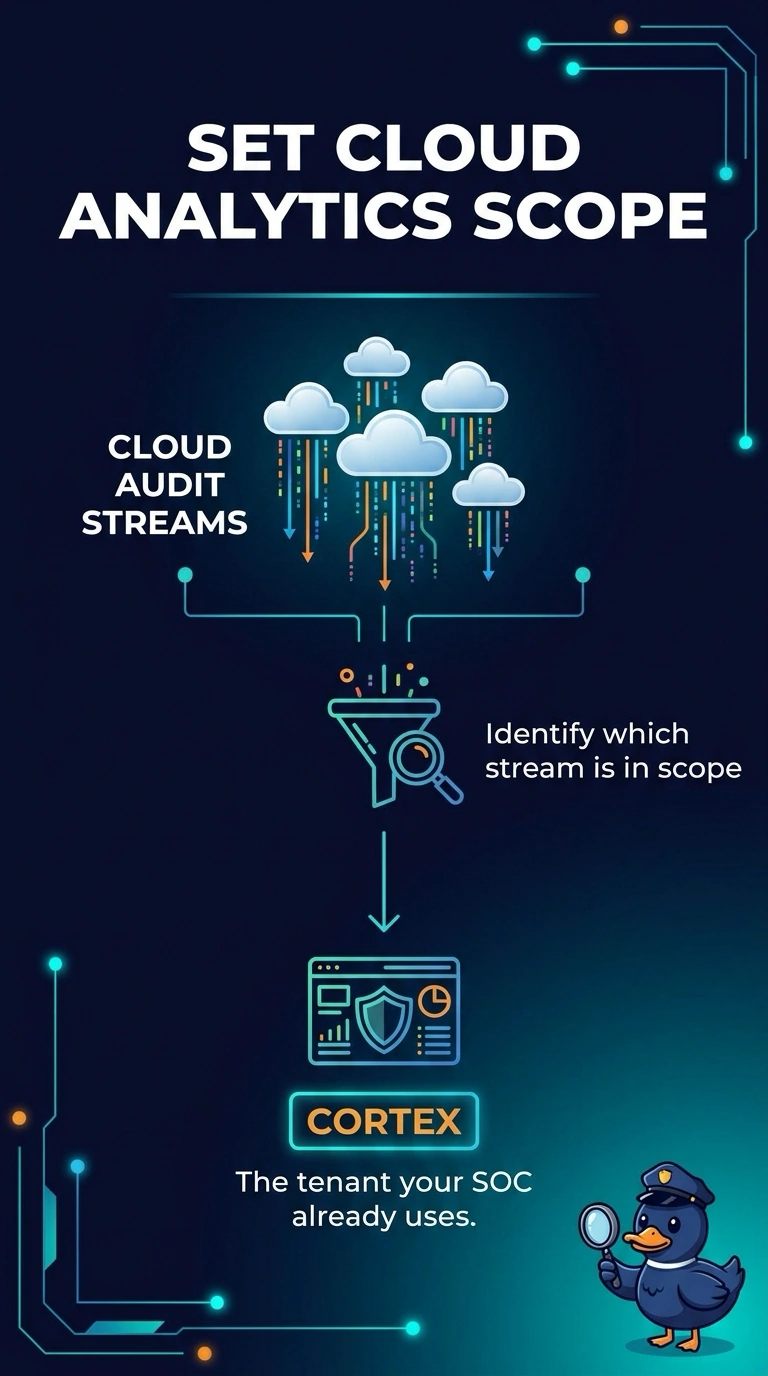
You already investigate detections in this Cortex tenant, so start by deciding which cloud audit stream analytics should ingest. A second detection product, Broker VMs at plants whose agents already reach Cortex, and outposts in accounts with no residency requirement don’t answer that scope question.
Full Explanation
Planning starts from the estate and the tools already in place. This SOC already investigates detections in its Cortex tenant, and XSIAM analytics on cloud audit logs is a capability selected when cloud accounts are onboarded. The plan should identify which cloud audit stream is in scope for that analytics path. A second detection product bought only to hold cloud audit logs duplicates a console the tenant family already provides and does not answer the scope question. A Broker VM is for a network that needs a bridge, such as endpoint routing or log forwarding where agents cannot connect directly; placing one in every plant, including sites whose agents already reach Cortex, is not the analytics decision. An outpost is for data residency or a boundary the customer must own. Accounts without such a constraint stay on cloud scan, so an outpost in every account is a cost and design choice, not a substitute for deciding the audit stream. Exam caveat: selecting analytics at onboarding does not replace posture rules. Attack path, configuration, identity, and the other rule families remain their own controls. Operational check: list the in-scope audit sources beside the cloud accounts, confirm analytics is the capability to enable for those sources, and leave a second product off the design until the list is agreed.