
Private endpoints in a plant must be reachable from the Broker VM, and the broker must still be able to update from Cortex and forward what it collects. Where should that broker be placed?
Select an answer to reveal the explanation.
Short Explanation
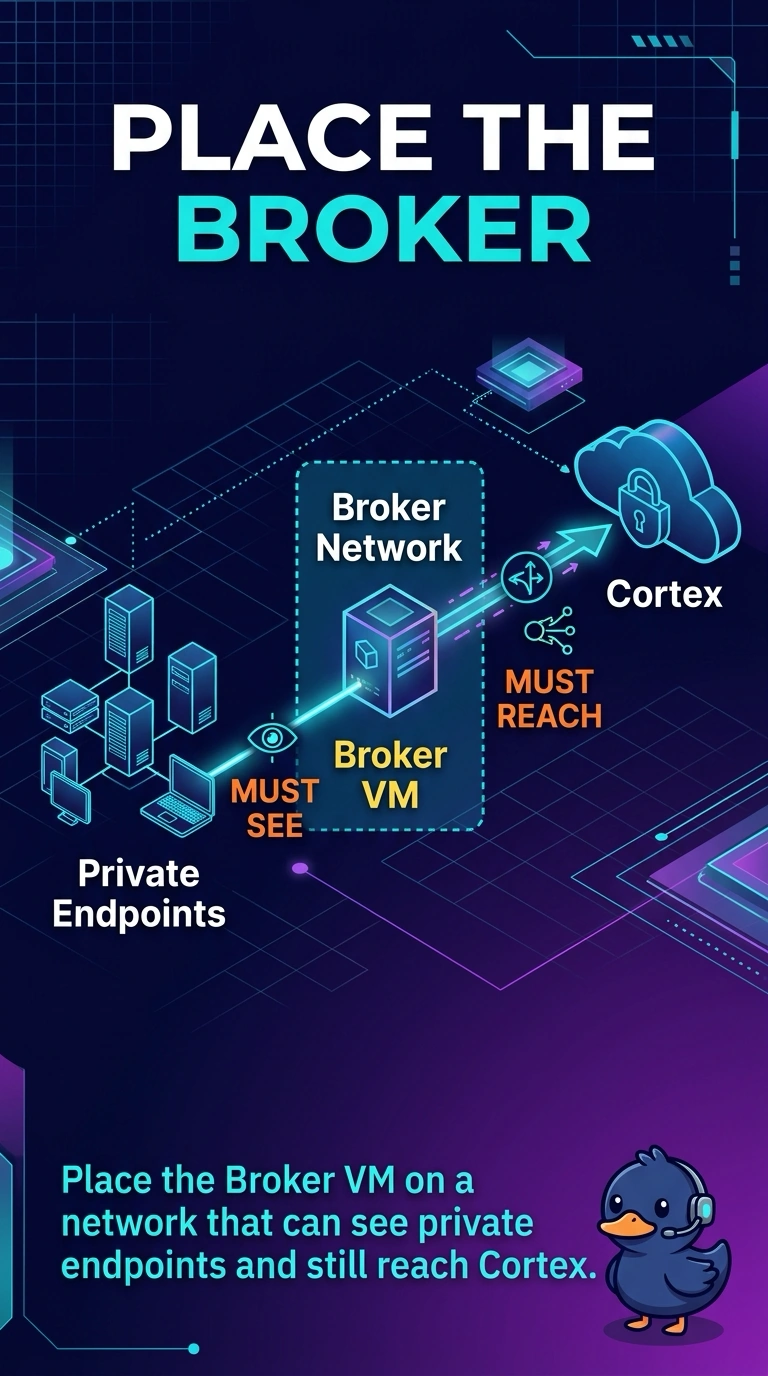
A bridge has to touch both banks. You place the Broker VM where it can see the plant's private endpoints and still reach Cortex for updates and forwarding. The trap is parking it on the public internet with no plant route, or stuffing it into an outpost account that never sees those endpoints.
Full Explanation
The Broker VM bridges the customer network for endpoint routing, log collection, and file forwarding, and it updates from Cortex. It has to sit on a network that can reach the private endpoints it is bridging and still reach Cortex, or it can neither see the plant nor take updates and forward results. Putting it on the public internet with no route into the plant leaves the private endpoints unseen. An outpost account is a dedicated home for scanner virtual machines that boot from a Cortex-owned image. Those scanners are not the broker, they do not need a path to plant endpoints to do their scan job, and placing the broker there as if it scanned accounts uses the wrong component. A developer laptop running the IDE plugin consumes application policy in the editor. It is not the plant bridge and it does not forward endpoint logs for the private network. Exam caveat: Permit the configured Agent Proxy/applicable applet ports; the agent-proxy listening port is configurable and commonly 8888, while caching/installer functions use their separately documented ports. Operational check: from the broker, reach one private endpoint and confirm the broker updates from Cortex and forwards a test log.