
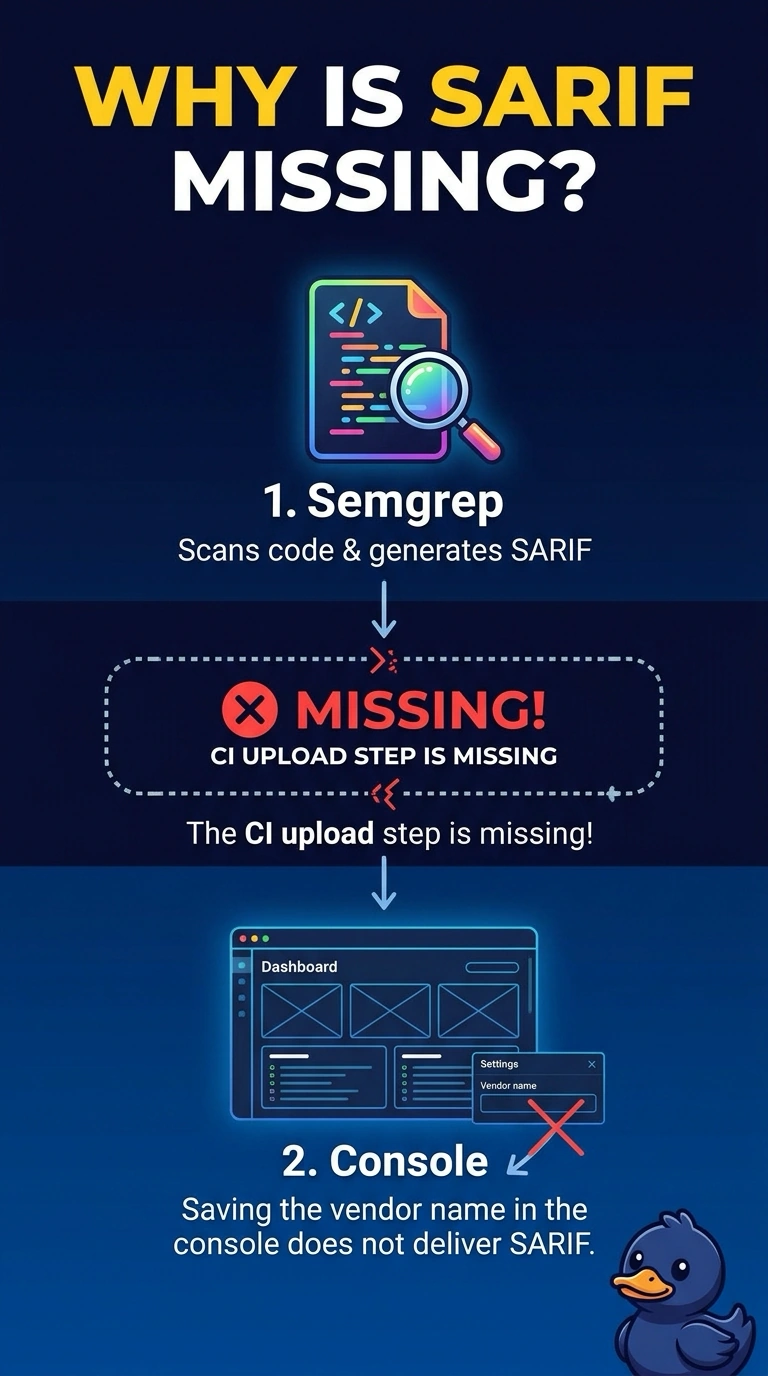
The team chose the Generic 3rd Party AppSec Collector to upload Semgrep SAST SARIF from CI; no native Semgrep API integration is configured. Semgrep is named in the console, but no SARIF findings appear, and the CI workflow never uploads a results file. Why is the integration producing nothing?
Select an answer to reveal the explanation.
Short Explanation
You chose the Generic collector route, so you need an authenticated SARIF upload for findings to be ingested. Remember, ASPM does not launch Semgrep for you, and Semgrep is not installed on your Broker VM. Once your upload lands, expect periodic issue creation rather than CI blocking.
Full Explanation
For the Generic 3rd Party AppSec Collector route, the missing authenticated SARIF upload prevents ingestion. You chose to upload Semgrep SAST SARIF from CI, with no native Semgrep API integration configured, so saving the vendor name in the console delivers nothing by itself. Native Semgrep integration instead retrieves SAST/SCA results periodically through its API; therefore, the absent CI upload is not a universal Semgrep integration defect. The idea that ASPM must launch Semgrep misunderstands the model: ASPM does not launch Semgrep and only consumes ingested results. Installing Semgrep on the Broker VM also fails by architecture: the VM is a closed appliance for endpoint routing, log collection, and file forwarding, updates from Cortex, and does not host third-party agents. The claim that native secret scanning replaced the SARIF path confuses separate scanners; secret scanning does not replace SARIF ingestion, so omitting the upload still leaves findings missing. Exam caveat: third-party SAST/code-weakness findings support periodic issue creation, not CI blocking; successful ingestion does not imply enforcement. Practical check: confirm that CI generates the SARIF file and runs an authenticated upload to the collector.