
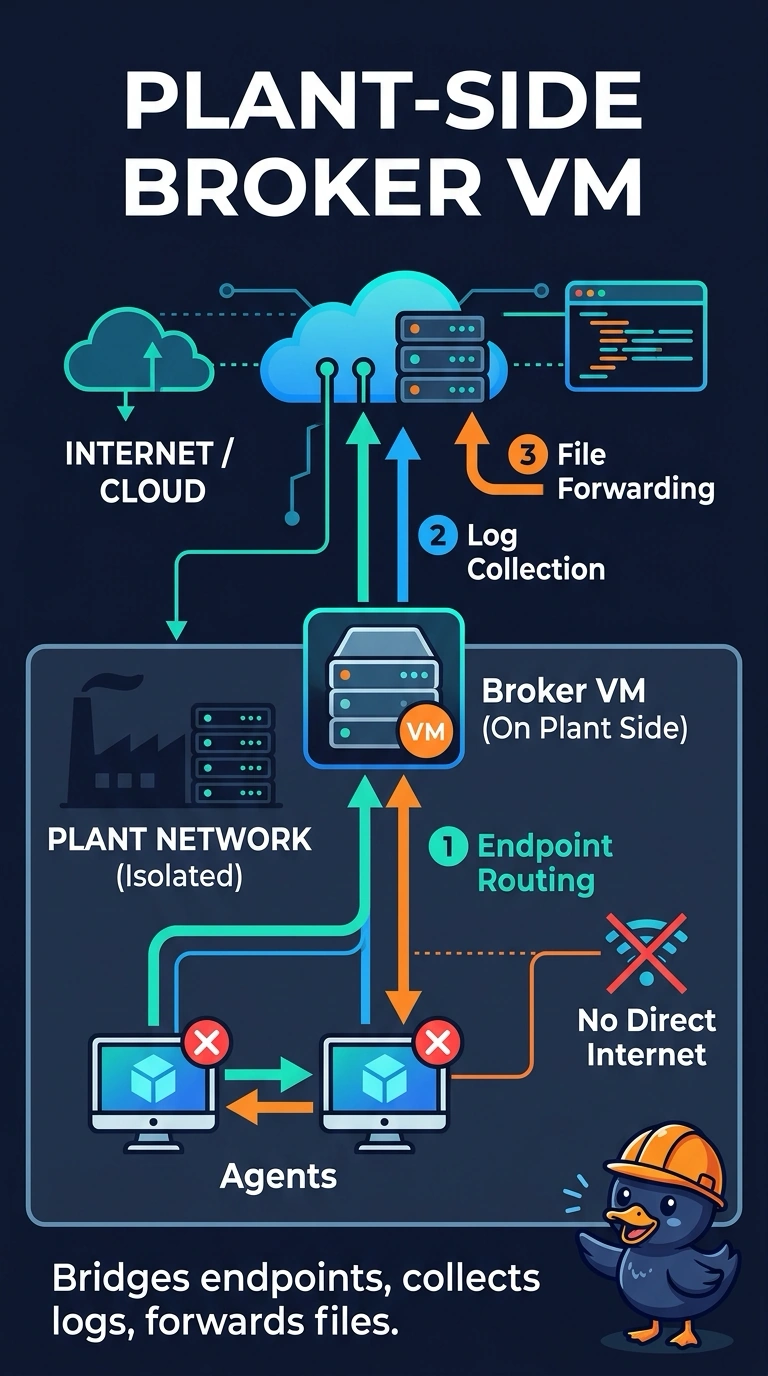
A manufacturing plant will not let agents open their own path to the internet, yet Cortex still needs endpoint routing plus log collection and file forwarding from that network. Which component belongs on the plant side?
Select an answer to reveal the explanation.
Short Explanation
Think of the broker as the guarded side door, not a second factory in the cloud. You need endpoint routing, log collection, and file forwarding from a plant that will not give agents their own internet path, and a Broker VM is that bridge. The trap is standing up an outpost or another tenant when the job is to cross the plant boundary.
Full Explanation
A Broker VM is a closed appliance that bridges the customer network to Cortex for endpoint routing, log collection, and file forwarding. The plant constraint is the missing public path for agents, so the broker is the component that sits where it can see that network and carry those three jobs. An outpost is a scan deployment in a dedicated cloud account. It pulls scanner images and returns results through cloud storage. It does not replace the plant bridge for endpoint routing and log forwarding. Cloud scan runs scanners on the Palo Alto Networks side and does not place an appliance in the plant, so it does not give agents a path when the plant blocks a direct route. A second tenant does not bridge the network. Agents and logs would still need a path into whichever tenant you choose. Exam caveat: the broker is not an outpost and it is not a cloud-scan replacement, even when it is the only appliance the plant will allow. Operational check: from a plant host, Verify the configured Agent Proxy listening port (commonly 8888) and each enabled collection applet port; separately permit the required broker-to-Cortex outbound connectivity. TCP 443 used for other broker functions is not a universal agent-proxy port. Then confirm the broker is forwarding logs and files and that agents check in through that bridge rather than through a new scanner fleet.