
A university requires Veracode as the static application security testing (SAST) system of record and still wants those results judged by Cortex application policies. How should the Veracode results enter Cortex?
Select an answer to reveal the explanation.
Short Explanation
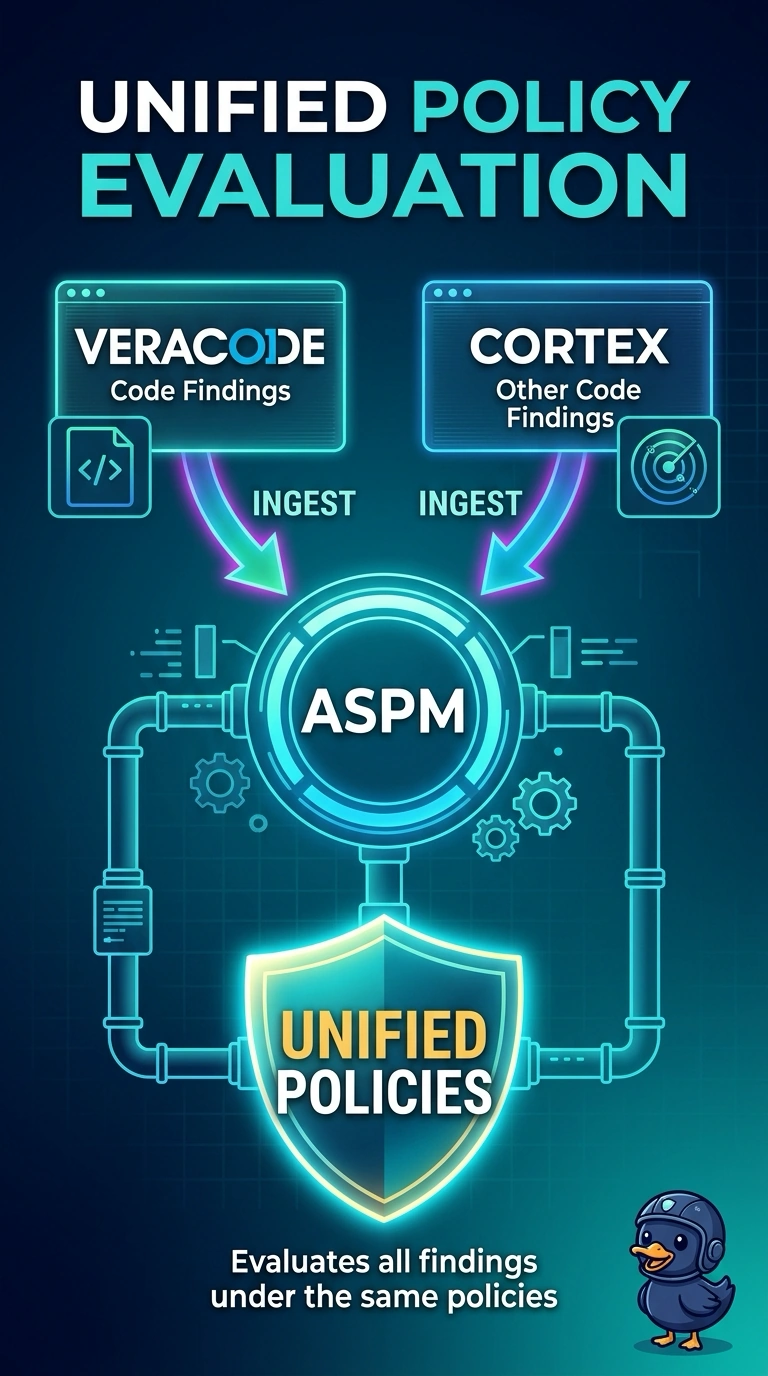
Veracode already did the lab work. You bring the results in so ASPM can judge them under the same unified policies as the other code findings. The trap is typing the vendor name and waiting for ASPM to start Veracode, or turning the feed into an agent profile.
Full Explanation
Veracode SAST findings are ingested so ASPM evaluates them under the same policies as native findings. ASPM does not run Veracode; the documented integration is for static application security testing (SAST). The university keeps Veracode as the system of record, and the Cortex side is the ingestion plus the unified policy, not a second scanner. A disk-scan Rego rule is an agentless cloud-workload check against an image. It is not how a SARIF or vendor SAST result becomes an application finding. Typing the vendor name does not launch scans. If the existing job never uploads results, ASPM has nothing to evaluate. An XDR prevention profile, assigned through endpoint groups, controls runtime prevention on hosts. It does not ingest SAST results or apply application-security urgency. Exam caveat: ingesting Veracode SAST does not replace native secret or IaC scanning unless those repositories are actually covered by what you ingested. Operational check: upload a Veracode SAST result, confirm the finding lands on the intended business application, and compare its urgency with a native finding for the same application.