
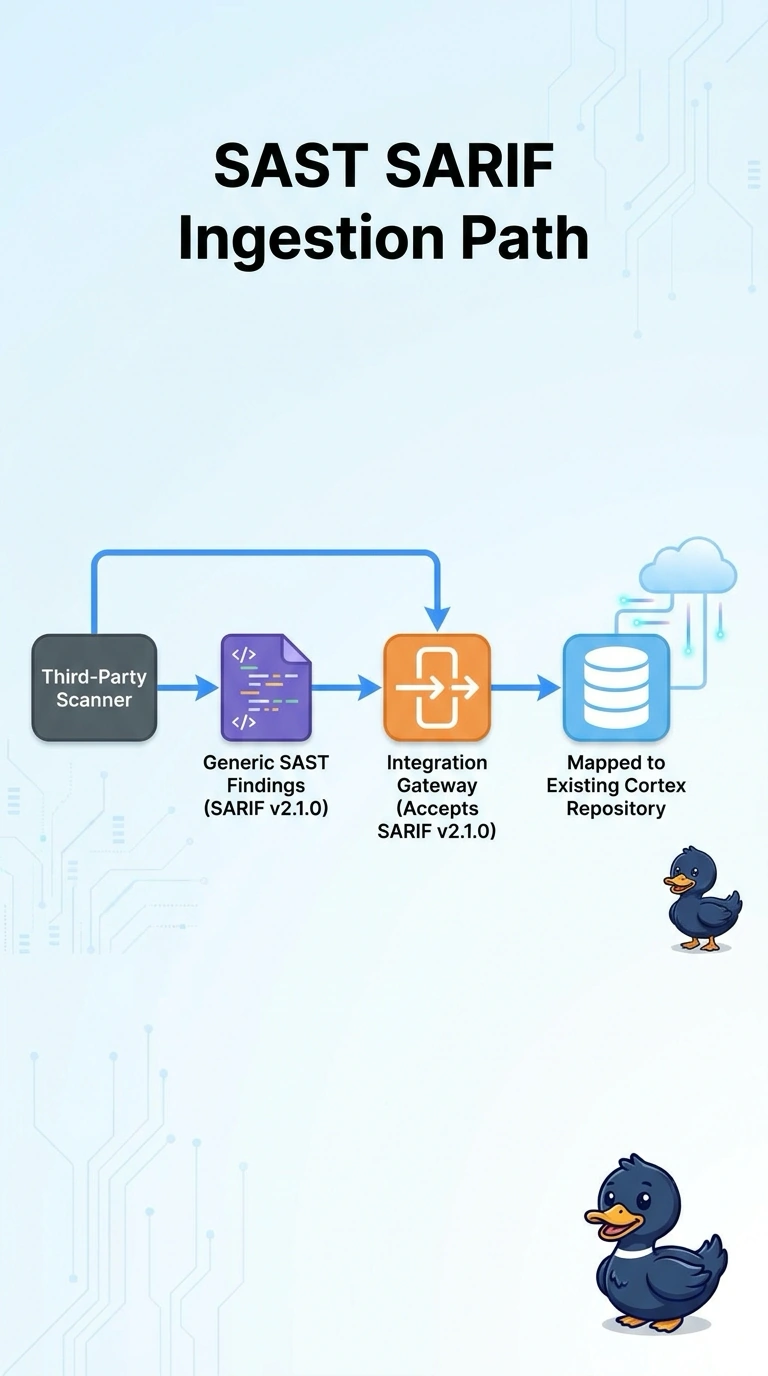
An internal scanner writes generic SAST findings in SARIF v2.1.0, mapped to an existing Cortex repository. The team wants ASPM to evaluate those results under application policies. Which ingestion path fits?
Select an answer to reveal the explanation.
Short Explanation
When you have generic SAST findings in SARIF v2.1.0, mapped to an existing Cortex repository, you hand that lab slip to the third-party scanner integration so ASPM can evaluate it. The trap is rewriting those rows as a pod spec, a disk-scan rule, or endpoint telemetry.
Full Explanation
An upload with generic SAST findings in SARIF v2.1.0, mapped to an existing Cortex repository is an accepted third-party ingestion, alongside Semgrep and Veracode, so ASPM can evaluate the internal scanner under application policies. ASPM does not run that scanner. The path is the SARIF integration, not a cloud-workload rule. A Kubernetes connector rule evaluates kind, metadata, and spec in package panw.compliance with a match rule. SARIF rows are not a pod spec, and the connector will not score them as one. Agentless disk scan runs Rego against an image. Pointing it at the runner image looks for workload findings on that image. It does not ingest an application SARIF file. A BIOC is a real-time behavior on endpoint or supported cloud-audit data and must filter event_type. A SARIF finding is not process telemetry, and encoding it as a BIOC skips ASPM. This collector supports SAST; it does not replace native secret, IaC or SCA coverage merely because another scanner can encode those categories in SARIF. Operational check: upload one SARIF, confirm the findings appear as application results on the intended business application, and confirm no cloud-workload rule was required for them to show up.