
An outpost must pull private customer images. An admin pasted the registry password into a tenant note, and scans still cannot authenticate. Where does that credential belong?
Select an answer to reveal the explanation.
Short Explanation
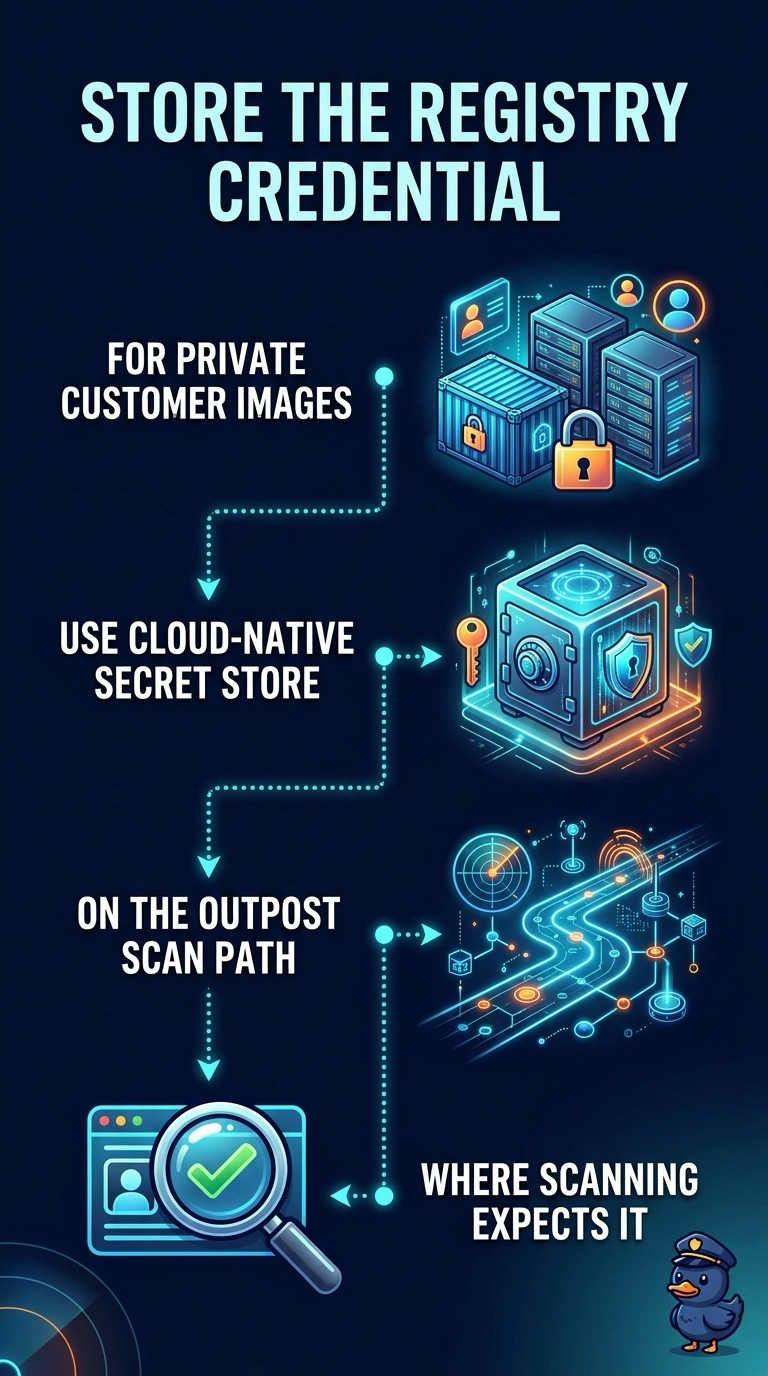
Think of a combination written on a sticky note instead of in the lock the night crew opens. Your outpost pulls private images with the credential in the cloud-native secret store the scan path expects. A tenant note is not that store, and the broker is the wrong box for this password.
Full Explanation
Registry credentials for outpost image pulls belong in the cloud-native secret store the outpost or integration expects. Pasting the password into a tenant note does not put it on that path, so scans cannot authenticate until the credential is in the store. A shared user password reused as the tenant API key breaks two rules: an API key carries its own role and is not a shared user password, and it is not the registry secret the scanner reads. A Broker VM is a closed appliance for agent routing, log collection, and file forwarding. Third-party agents are not installed on it, and it does not hold the outpost's registry pull secret. A static asset group is a hand-picked list of assets. It cannot be an access scope, and a group name is not a registry credential. Exam caveat: the outpost account is dedicated and bound to one tenant, but that binding does not move a note in the tenant into the cloud secret store. Operational check: place the password in the expected secret store, delete the tenant note, and confirm the outpost pull authenticates for a private image.