
A lab uses GitLab for source code and for container images. The version-control connection already delivers pipeline events, but vulnerability scans of the GitLab registry stay empty. What else is required?
Select an answer to reveal the explanation.
Short Explanation
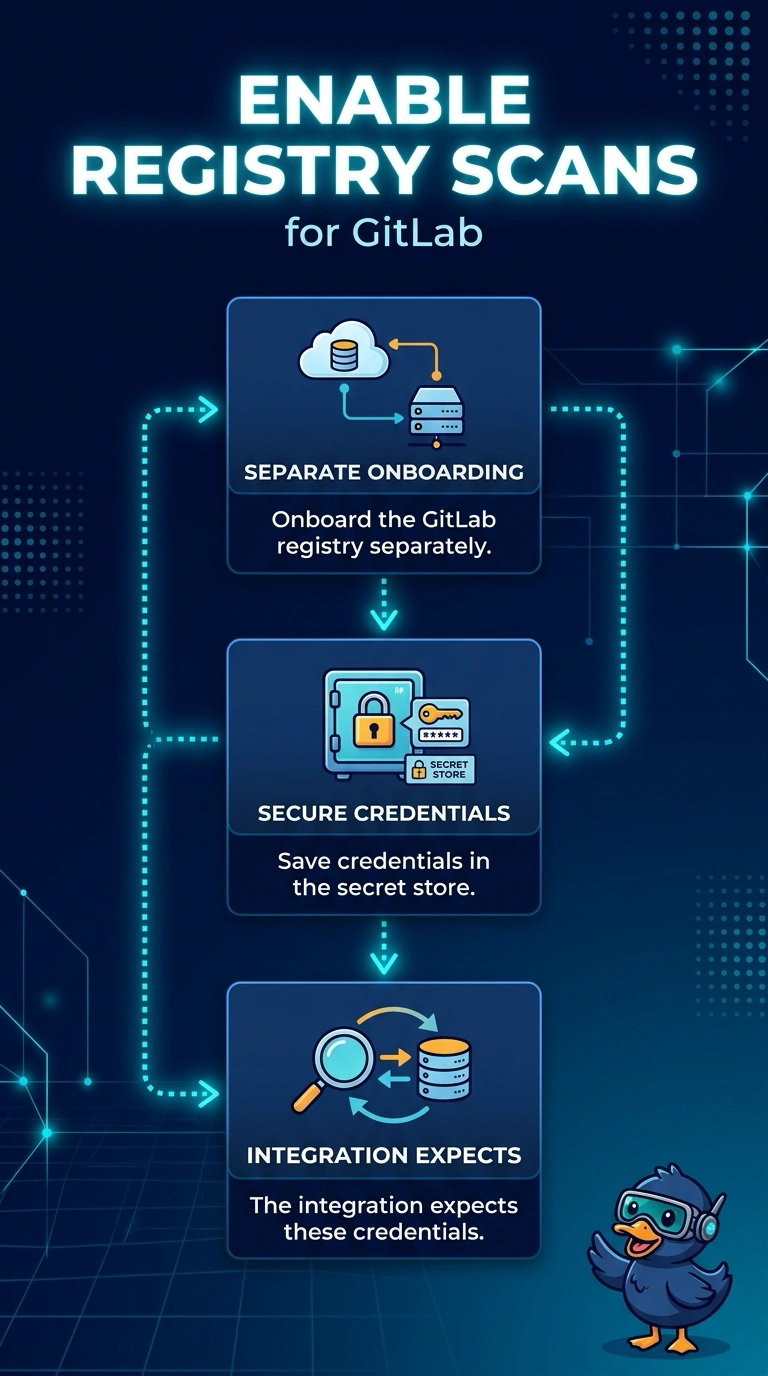
Think of GitLab as a library that also runs a package counter down the hall. You already connected the source code, and webhooks from that side do not scan the images. Provide the registry credentials through the selected scan-mode workflow; cloud, outpost and Broker modes have distinct credential/configuration steps.
Full Explanation
GitLab can be both the git host and the registry, and those are separate onboardings. The version-control connection uses OAuth or a personal access token plus webhooks so pipeline events arrive. A registry connection is an image source for workload scanning. Provide the registry credentials through the selected scan-mode workflow; cloud, outpost and Broker modes have distinct credential/configuration steps. Check whether a registry connector exists and its scan status; an empty findings list alone does not prove missing onboarding. Version-control webhooks do not scan every image in the registry. They deliver development-system events, and that connection does not by itself scan a registry or a cloud account. An AWS read-only role is a cloud-account identity. It does not replace either the GitLab code connection or the registry credential. The broker bridges endpoint routing, log collection, and file forwarding. A Broker rebuild alone does not configure a registry connector, though a supported Registry Scanner applet can scan through Broker mode. Exam caveat: connecting the registry still does not deploy an XDR agent on a node. Image findings and runtime prevention remain different coverage.