
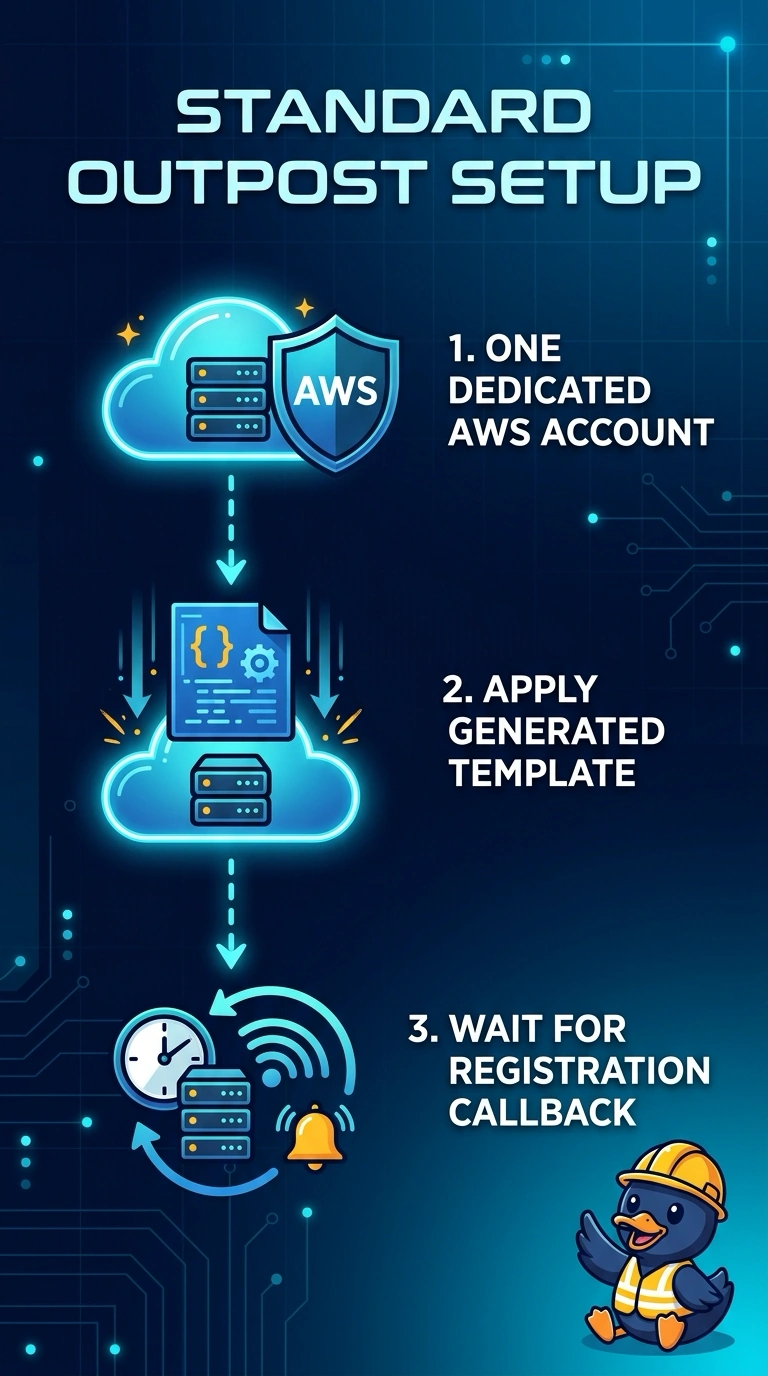
A community college wants a standard Cortex Cloud outpost for one AWS account. Which sequence matches that design?
Select an answer to reveal the explanation.
Short Explanation
Think of a standard outpost as a kit you apply, then a doorbell that rings when it is registered. You apply the generated template in a dedicated account and wait for the callback that moves Pending to Connected. Hand-building a VPC, or renaming cloud scan, is a different design.
Full Explanation
A standard outpost is a Cortex-generated template, Terraform or CloudFormation on AWS, applied in a dedicated account that holds no other workloads. The outpost moves from Pending to Connected after the registration callback. That is the sequence for the college's single AWS account. One outpost is bound to one tenant and to that one account. Writing a custom VPC and custom egress is the custom-outpost path, and Connected is not a status someone types by hand in place of the callback. A Broker VM is a closed appliance for bridging a customer network. It is not an outpost and it does not belong in the application account as a stand-in. Cloud scan is the managed scanner path. Calling it a standard outpost misnames the mode and skips the dedicated account. Exam caveat: the scanner VMs still need egress to the image-source account or scanning never starts, even after the status shows Connected. Operational check: confirm the template landed in an otherwise empty account, confirm the callback moves the outpost to Connected, and confirm the account is not shared with application workloads.