
A pipeline runs a cortexcli image scan on a clinic base image. The report lists a vulnerable package, a malware hit, and a secret in a layer. A developer then asks that same command to rewrite the unified application security policy. What does this image scan do?
Select an answer to reveal the explanation.
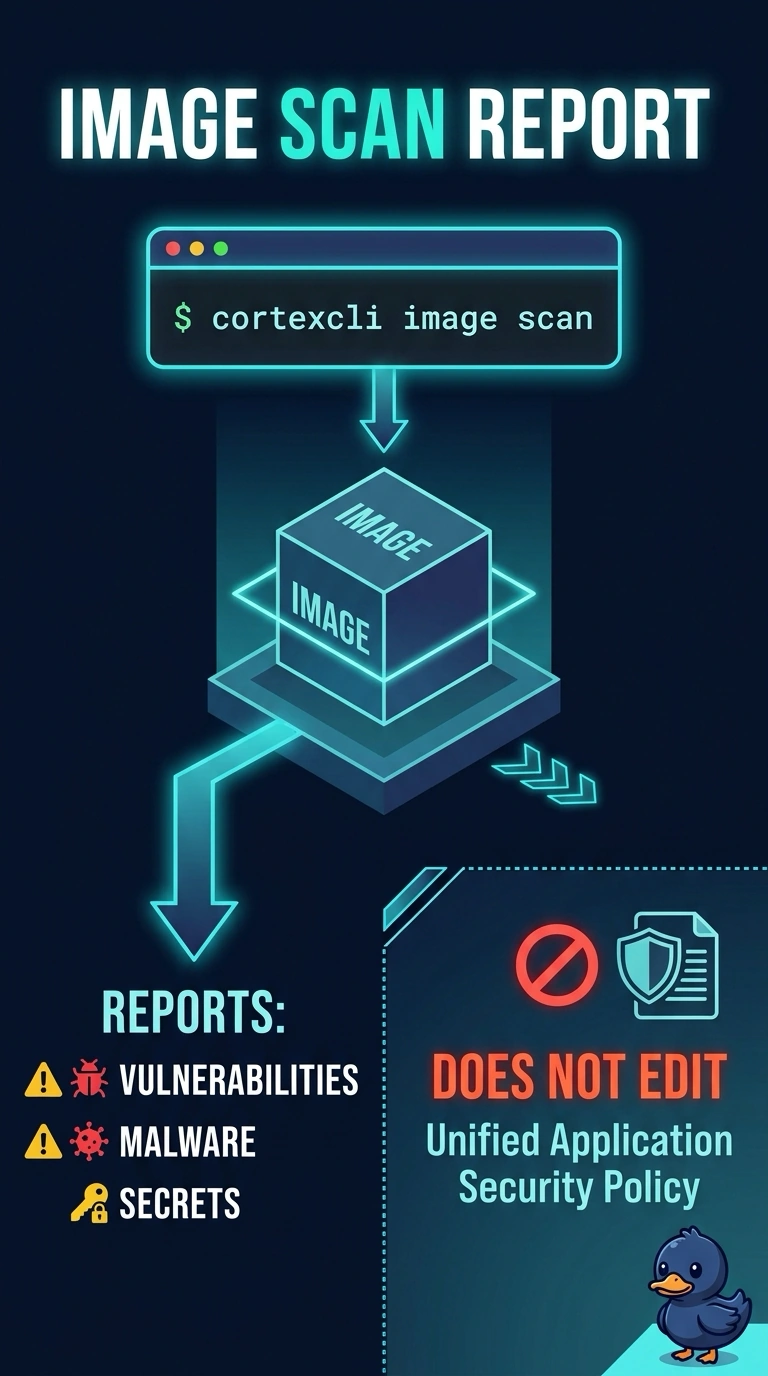
Short Explanation
The packing scan tells you the crate is damaged, and it does not rewrite the warehouse rulebook. You ran an image scan, and that module reports vulnerabilities, malware, and secrets in the image. The trap is expecting the same command to edit the unified policy or to block a pod.
Full Explanation
The cortexcli image-scan module reports vulnerabilities, malware, and secrets found in the image. That is what the clinic report is showing. The CLI consumes policy. It does not create, edit, or delete it. Policy authoring stays in the console, the API, or Terraform, so this command does not rewrite the unified application security policy or turn the CI trigger off. Admission control that blocks a new Kubernetes deployment is a prevention action, and Admission blocking requires a configured Kubernetes Connector admission controller and enforcement policy; real-time agent protection is a separate optional connector capability. An image-scan report in CI does not perform that block by itself. Onboarding a cloud account and enabling DSPM is a cloud integration. It is not what an image-scan command does to a base image, and DSPM classifies data stores rather than editing application policy. Exam caveat: the scan enforces a gate only when the pipeline treats a non-zero exit status as a failure. A report full of findings can still leave the job green. Operational check: open the image-scan output, confirm the package, the malware hit, and the layer secret are all in that report, and confirm the unified policy text did not change during the run.