
Infrastructure-as-code drift shows a storage account that no longer matches the Terraform module. The team expects Cortex to put the cloud object back. What does drift detection do?
Select an answer to reveal the explanation.
Short Explanation
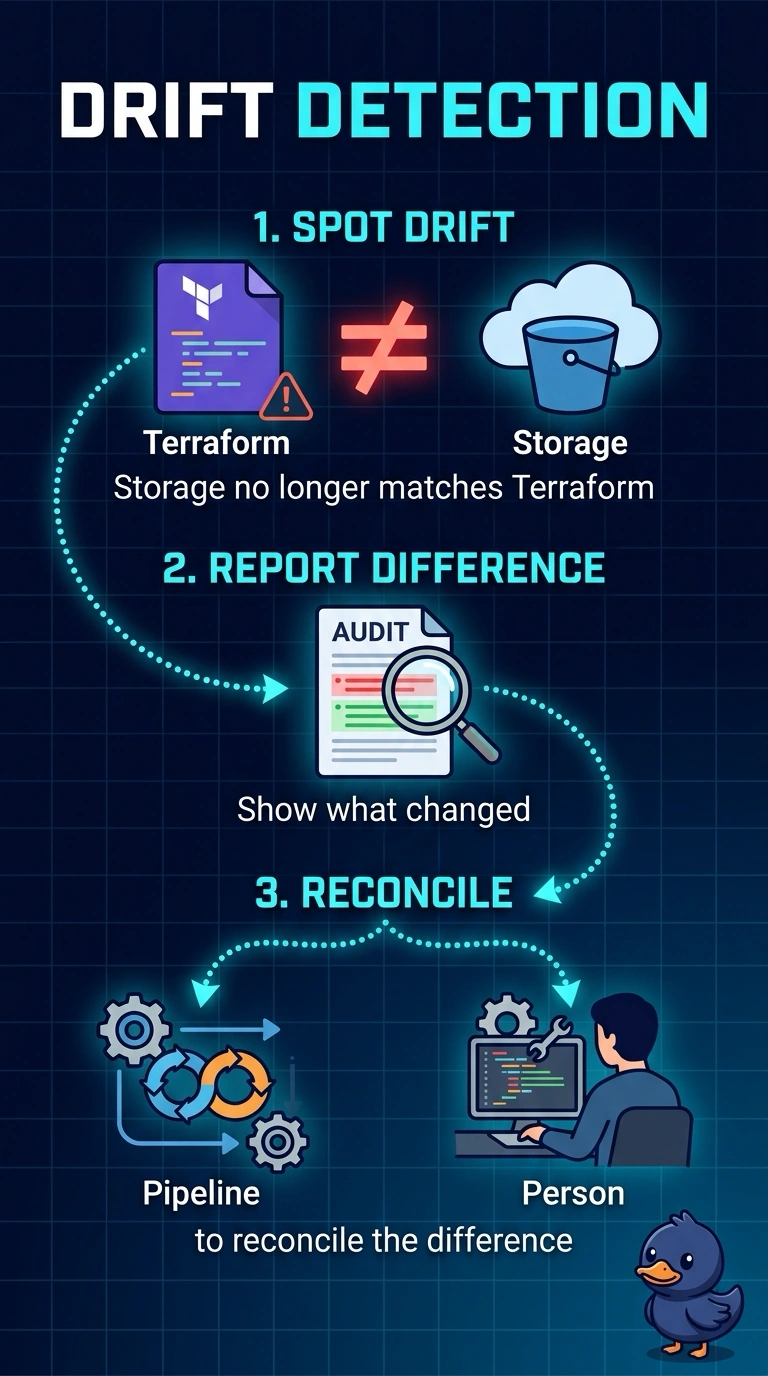
Think of a surveyor who marks where the fence moved without swinging a hammer. Your drift report shows that the storage account and Terraform module disagree, so a pipeline or person can reconcile them; detection does not put the cloud object back on its own.
Full Explanation
Infrastructure-as-code drift means the live storage account no longer matches the Terraform module. Drift detection reports that difference so a pipeline or a person can reconcile it; it does not revert the cloud object on the next scan. Until someone or some pipeline changes the cloud object or the module, a later scan can report the mismatch again. An issue based on a vulnerability score and a failed build describe vulnerability-policy handling of a vulnerable component, not detection of a difference between deployed infrastructure and its template. The phrase “without an agent” does not change the nature of drift detection: it still reports the mismatch rather than applying an automatic rollback. A cardholder data profile is for classifying PCI-related patterns in data stores, not for mapping infrastructure differences. Masked samples are a classification-related collection choice, not a way to store evidence of a template diff. Exam caveat: reporting drift does not mean the cloud resource has been changed or that Terraform has reconciled it; do not assume remediation occurred just because a scan found the difference. Practical check: open the drift report, compare the live storage setting with the corresponding module line, reconcile the two through a pipeline or manually, and confirm that the next drift scan no longer reports the account.