
A guardrail in the unified policy is written for Terraform misconfigurations. A pull request only bumps a Python dependency that has a known vulnerable release. Why does that guardrail stay quiet?
Select an answer to reveal the explanation.
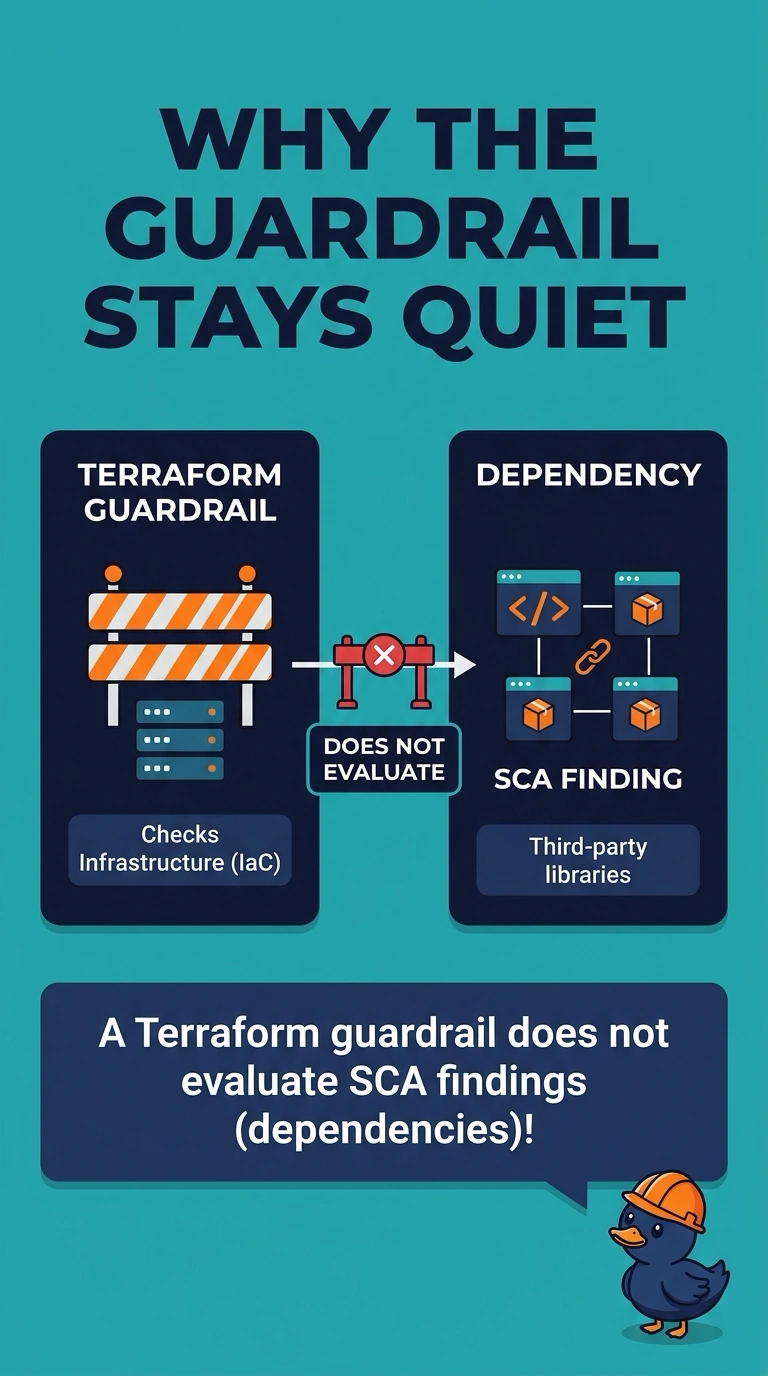
Short Explanation
Think of a Terraform guardrail as a spell-checker for blueprints, not a lab test for ingredients. You changed a Python dependency, so the risk belongs to SCA. The guardrail stays quiet because it was not written to judge that package.
Full Explanation
A Terraform-focused guardrail evaluates infrastructure code for Terraform misconfigurations; it does not inspect a Python package for vulnerable releases. That dependency risk is a software composition analysis (SCA) finding, so the guardrail stays quiet because the pull request changed a dependency rather than Terraform. An IDE plugin finding does not itself fail a merge or prevent a guardrail from running; pull-request blocking is determined by the platform scan, not by stopping guardrails. IaC drift compares deployed infrastructure with the repository and concerns a mismatch between live state and code, not a vulnerable library in a pull request. License review checks whether a package’s license is permitted; it does not identify a vulnerable release, so it is the wrong kind of scanner for this issue. Exam caveat: if the same pull request also changes Terraform, the Terraform guardrail may still evaluate that file while SCA reports the dependency separately; silence about the package does not mean the policy set is disabled. Practical check: inspect the pull-request results, verify that SCA reports the vulnerable Python release, and confirm that there is no Terraform diff for the guardrail to assess.