
A build pulls a vulnerable library only through another package. The developer pins the direct dependency and the finding remains. What is going on?
Select an answer to reveal the explanation.
Short Explanation
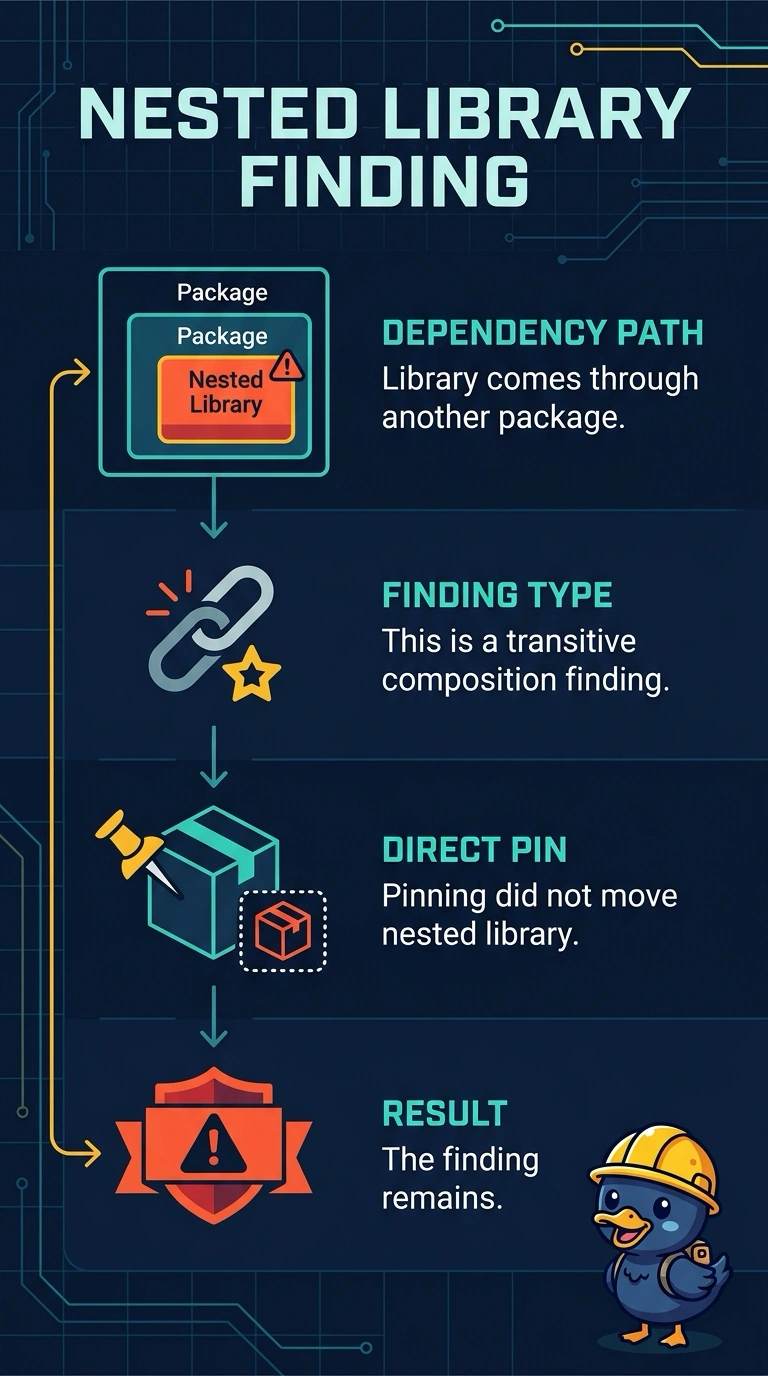
Think of the direct dependency as the box you ordered and the vulnerable library as an item packed inside it. You pinned the box and left the item inside untouched. That is a transitive composition finding, so the pin can succeed and the finding can stay.
Full Explanation
Software composition analysis covers direct and transitive dependencies. A vulnerable library that arrives only through another package is a transitive finding. Pinning the direct dependency changes the parent you named and does not necessarily move the nested library, so the finding remains until the transitive component itself changes. An infrastructure misconfiguration, such as an open security group in Terraform, is an IaC result. A version pin in a package manifest does not close a security group and this symptom is not that scanner. A secret in a chart is key material committed in Git. Rotating a key does not describe a library that arrived through another package. License drift is not a scanner name in this product. License findings are their own scanner, and IaC drift is a deployed template that no longer matches the repository. Neither one is a nested library CVE, and a pin has a package to move when the transitive coordinate is the thing you change. Exam caveat: urgency in application security can still rank this transitive issue using exploit likelihood and known exploited status. That ranking does not change which scanner found it. Operational check: open the composition result, note the parent package and the nested library, and confirm the lockfile still resolves the vulnerable nested version after the direct pin.