
A Helm chart in Git contains a committed private key. The pipeline reports it, and a reviewer calls the report a Terraform syntax error that a formatter will clear. What finding type is it?
Select an answer to reveal the explanation.
Short Explanation
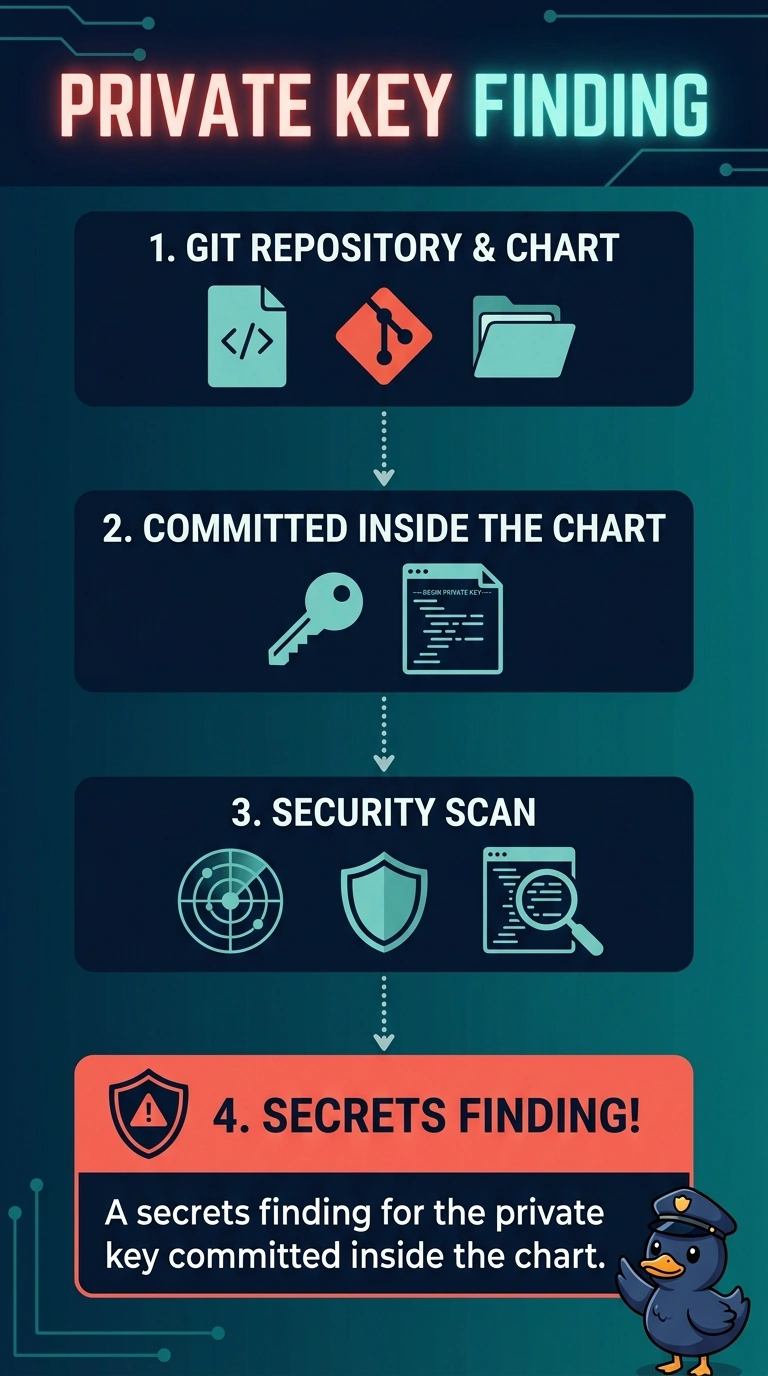
Think of the private key as a house key photocopied into the recipe book. You do not fix that with a formatter that straightens the indentation. The pipeline is reporting a secret committed in the chart, and the key has to come out of Git.
Full Explanation
Secrets scanning and infrastructure-as-code scanning are different scanners. A private key committed in a Helm chart is a secrets finding. A formatter can clean syntax and will not remove key material, so treating the report as a Terraform syntax error sends the author to the wrong repair. A license finding flags a disallowed license. The chart can have a license issue on some other file, and that issue is not what a committed private key is. Composition analysis reports vulnerable direct and transitive libraries. A key file committed beside the chart is not a transitive dependency, and pinning a package version will not delete it from Git history. Exam caveat: a license finding or a composition-analysis finding can exist on other files in the same chart, and neither one clears a private key that is still in Git. Operational check: remove the key from the chart, rotate the key so the committed copy is useless, and confirm the next pipeline run shows the secrets finding cleared on the new commit.