
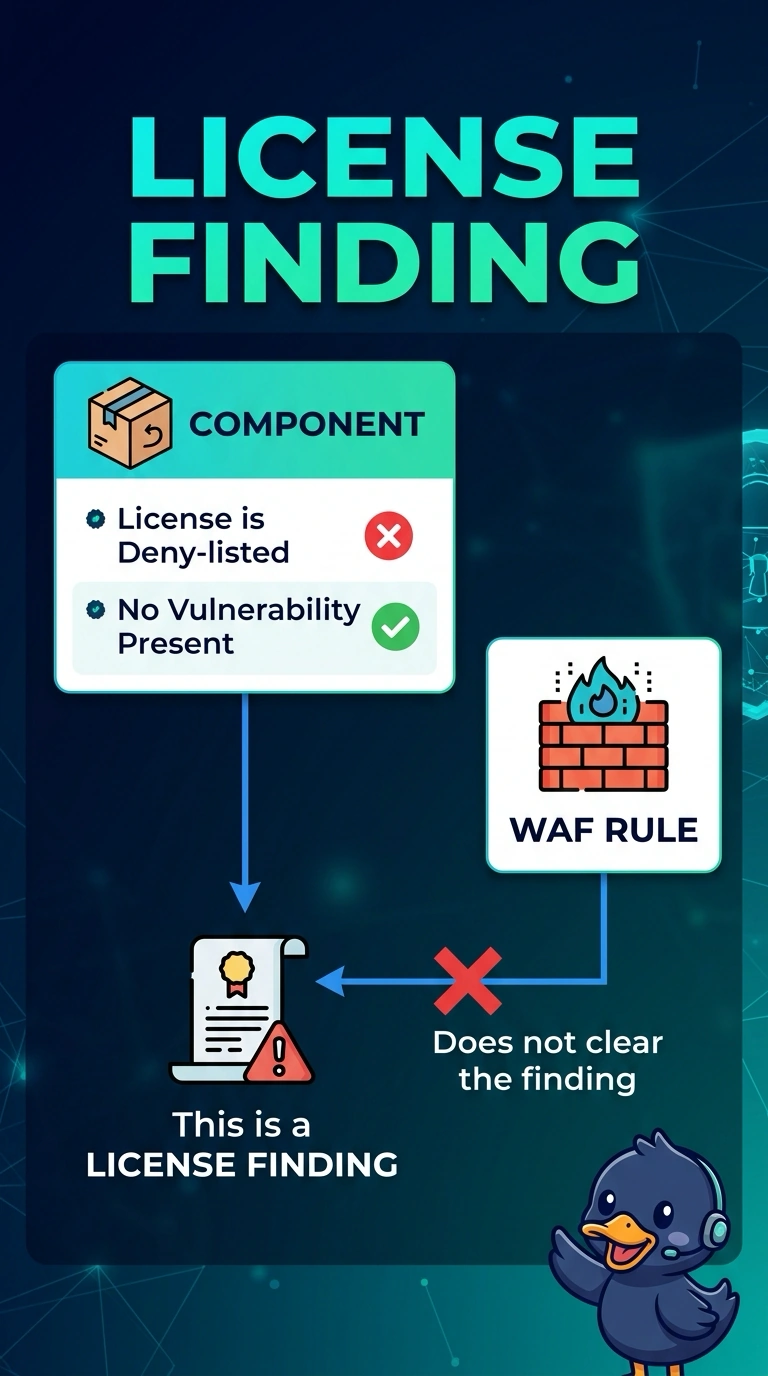
A pipeline flags a component whose license is on the company deny list. The component has no vulnerability. A reviewer plans to clear the finding with a web application firewall rule. What finding is this?
Select an answer to reveal the explanation.
Short Explanation
Think of a denied license as a contract problem, not a hole in the running website. You can put a firewall in front of the app and the component is still on the deny list. This is a license finding, and a firewall rule does not remove it.
Full Explanation
License scanning is its own scanner, separate from SCA vulnerabilities, secrets, IaC, and IaC drift. A component on the company license deny list is a license finding even when it has no vulnerability. A web application firewall rule does not change the license of a dependency and does not clear the finding. Calling it a vulnerability that the firewall can virtually patch invents a CVE the pipeline did not report and treats a license as something a production filter can patch. Infrastructure drift is a deployed template that no longer matches the repository. A firewall policy and a license deny list are not that comparison, so drift is the wrong family. A secrets finding is committed key material. License text is not a private key, and classifying the deny-list hit as a secret sends the author to rotation instead of to a license decision. Exam caveat: urgency ranking can still mark a different issue on the same component as urgent because of exploit likelihood. That ranking does not convert this license hit into a vulnerability. Operational check: open the license result, confirm there is no vulnerability on the component, and clear it only by replacing the component or accepting the license through the policy, not by adding a firewall rule.