
A developer opens a pull request that adds a Terraform security group and a committed API key. Which policy set is supposed to evaluate that code change?
Select an answer to reveal the explanation.
Short Explanation
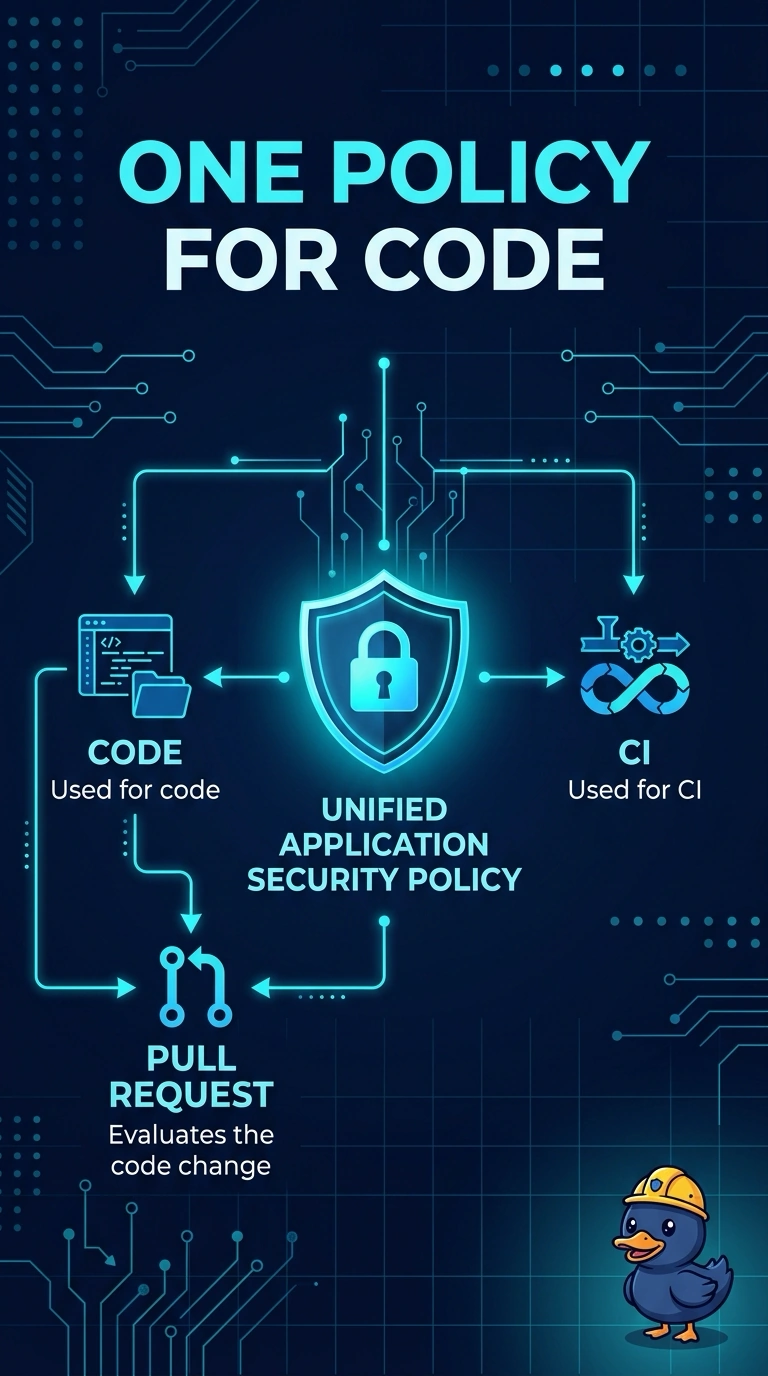
You can treat the pull request as code to review and the unified application security policy as your checklist for that review. It evaluates both secrets and infrastructure-as-code; a Cloud Workload image rule, an endpoint prevention profile, and a data-classification profile each target something else. The key is matching the policy to the code change, not to the security terms mentioned in it.
Full Explanation
The unified application security policy is intended for code and CI, so it evaluates both parts of this pull request: the Terraform security group is infrastructure-as-code, and the committed API key is a secret. Those findings can be evaluated by a pull-request scan or in CI. A Cloud Workload image rule targets layers in a container-registry image, not the pull request itself; the possibility that the code might eventually produce an image does not make an image rule the control for reviewing the code change. An endpoint prevention profile applies to an endpoint in its assigned group, such as the developer’s laptop, rather than parsing the pull request’s Terraform or detecting its committed key as a code-review policy. A data-classification profile such as PCI or PHI applies to a cloud data store being classified, not to a git diff containing source code and a secret. Exam caveat: an IDE Scan trigger can report findings in the editor, but that does not itself block a merge; the platform pull-request scan is the relevant merge-time check. Practical check: verify that the unified application security policy includes both secret and infrastructure-as-code rules, and that the pull-request trigger is enabled for this repository.