
A law firm tracks how long application issues stay open. A vulnerability policy labels the same vulnerability as high on production assets. What runs the application issue SLA clock?
Select an answer to reveal the explanation.
Short Explanation
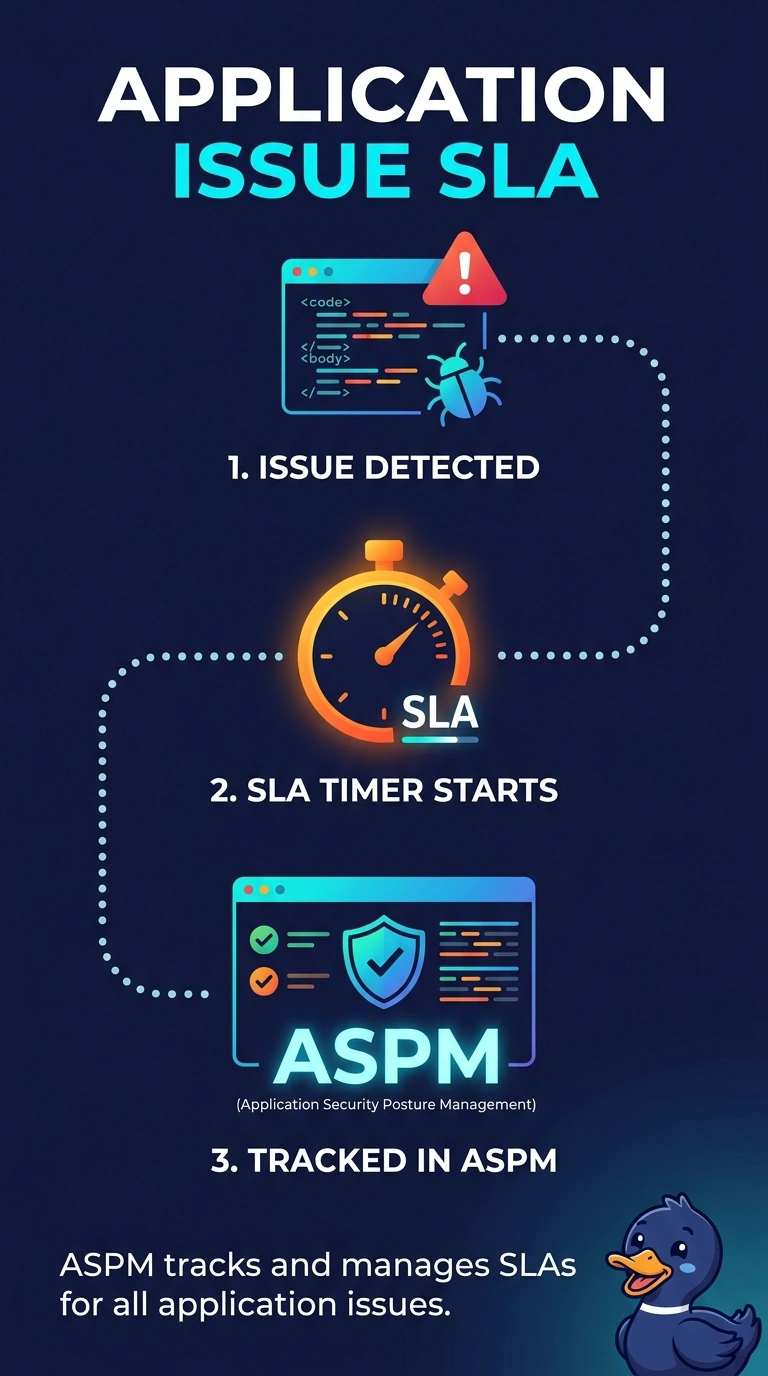
Think of the SLA as the clock on the case file, not the stamp someone put on a different form. You track application issue age in ASPM, where issue SLAs live. A high vulnerability-policy severity is a real label, but it does not start that clock by itself.
Full Explanation
ASPM tracks issue SLAs on application issues. The law firm's clock for how long an application issue stays open is the application-issue SLA, not a label from another policy family. A vulnerability policy chooses issue creation or ignore, and prevention, for a vulnerability finding, using first match and a scope; its severity is not the ASPM SLA timer. A CVSS score can be an input to a vulnerability policy, but it is not the timer by itself. ASPM urgency uses other context, such as EPSS, CISA KEV, code-to-cloud, business criticality, and runtime protection, so neither CVSS nor an urgency label is the SLA clock by itself. An admission-controller block is a prevention action on a new Kubernetes deployment when the agent and controller are in place; it does not start an application issue SLA. Exam caveat: urgency and SLA are both ASPM ideas, and a Top Urgent issue can still miss its SLA if nobody works the issue. Practical check: open the application issue, read its SLA timer, and confirm it is not being copied from the vulnerability-policy severity on the production asset.