
A toy maker's repository shows no application issues, and coverage shows the scanner never ran in the pipeline. How should the team read that result?
Select an answer to reveal the explanation.
Short Explanation
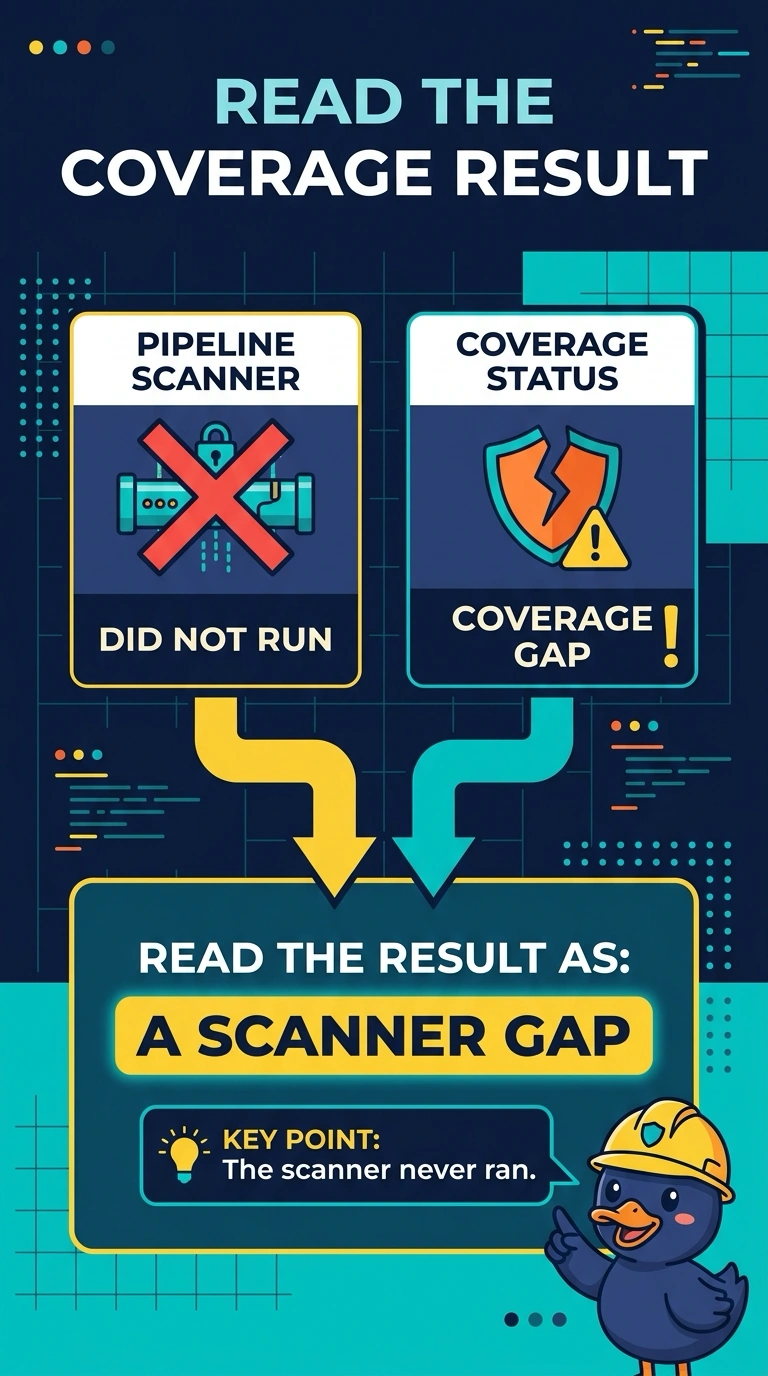
Think of coverage as the attendance sheet, not the grade. You have no issues because the scanner never reached the pipeline, and that is a gap, not a clean application. Calling it a false negative assumes a scanner that actually finished.
Full Explanation
Coverage shows which repositories and pipelines a scanner actually reached. The toy maker's coverage says the scanner never ran, so the empty issue list is a coverage gap. It is not evidence the application is clean. Reading it as a clean application treats missing work as a passed inspection. A false negative is a miss inside a scanner that ran and failed to report a real problem. That story does not fit a pipeline the scanner never entered. Removing the unified policy because it seems too strict deletes the rules before they have been applied. The policy never had a chance to match, because the scanner did not run. The missing scanner step has to be added in the pipeline before an empty issue list can be read as a result. Exam caveat: an IDE finding can still appear on a laptop while the pipeline coverage stays empty, and the IDE result does not prove the pipeline ran. Operational check: open coverage for the repository, confirm the pipeline job does not invoke the scanner, add that step, and only then treat an empty issue list as a scan result.