
A payments company wants ASPM to rank which application issues are most urgent. Which inputs does that ranking use?
Select an answer to reveal the explanation.
Short Explanation
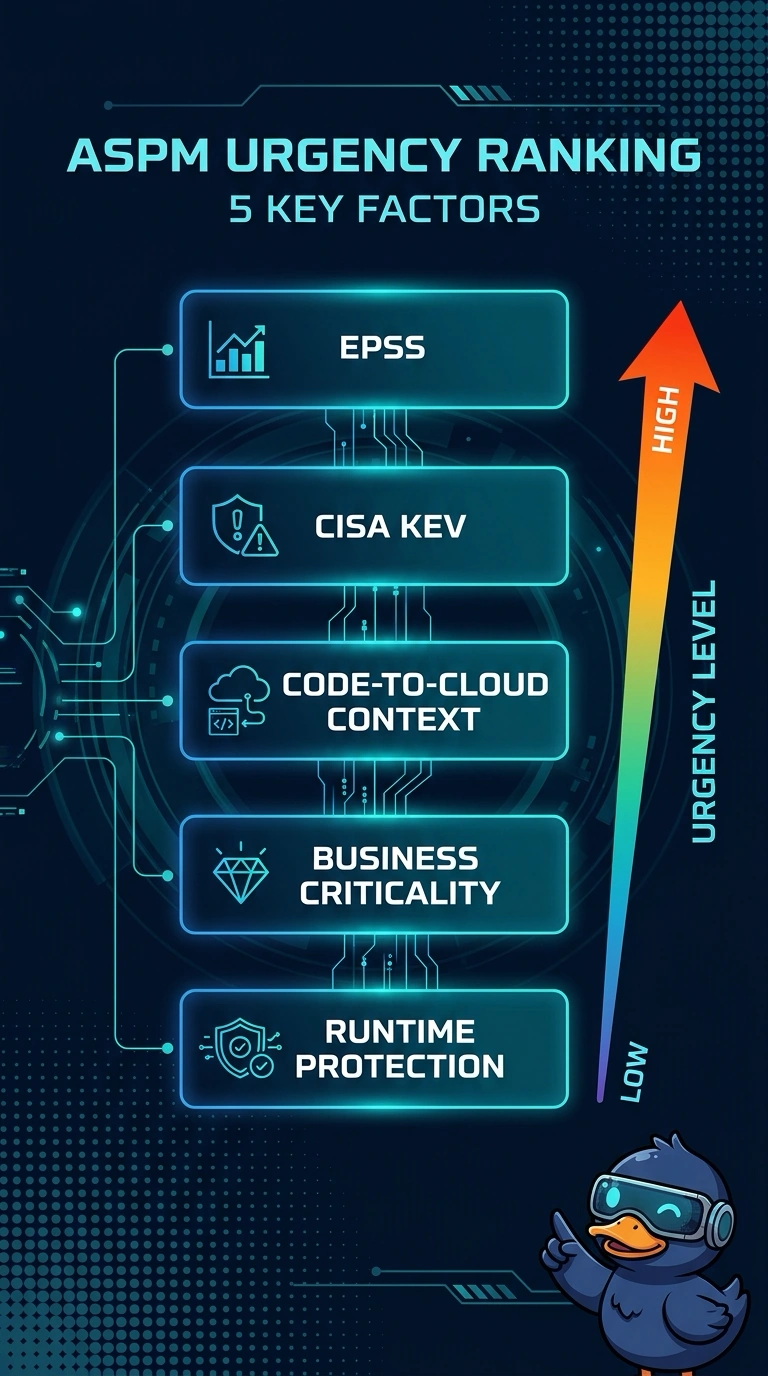
Think of urgency as a triage nurse using several charts, not a single lab number. You rank application issues with EPSS, CISA KEV, code-to-cloud context, business criticality, and whether runtime protection is present. Sorting by CVSS alone is the trap.
Full Explanation
ASPM urgency uses EPSS, CISA KEV, code-to-cloud context, business criticality, and runtime protection. Those inputs together decide whether an application issue is top urgent, urgent, not urgent, or not applicable. CVSS alone is the wrong sort. CVSS can drive a vulnerability policy, and a critical issue for a CISA KEV vulnerability on a production group does not even require a high CVSS score when that policy says so. Reusing a vulnerability policy's first-match action as urgency mixes a posture policy action with ASPM ranking. First match decides issue creation or prevention for that finding. It is not the urgency formula. An admission-controller block is one runtime-prevention outcome on Kubernetes. Using only that block drops EPSS, KEV, code-to-cloud context, and business criticality. Exam caveat: urgency is not the issue SLA. A top-urgent item still has its own SLA clock. Operational check: open two issues with similar CVSS and different KEV or runtime-protection context and confirm ASPM ranks them differently.