
A veterinary teaching hospital wants its clinic application's repositories, pipelines, and cloud assets grouped so urgency and issue SLAs have a home. What should the team expect ASPM to do?
Select an answer to reveal the explanation.
Short Explanation
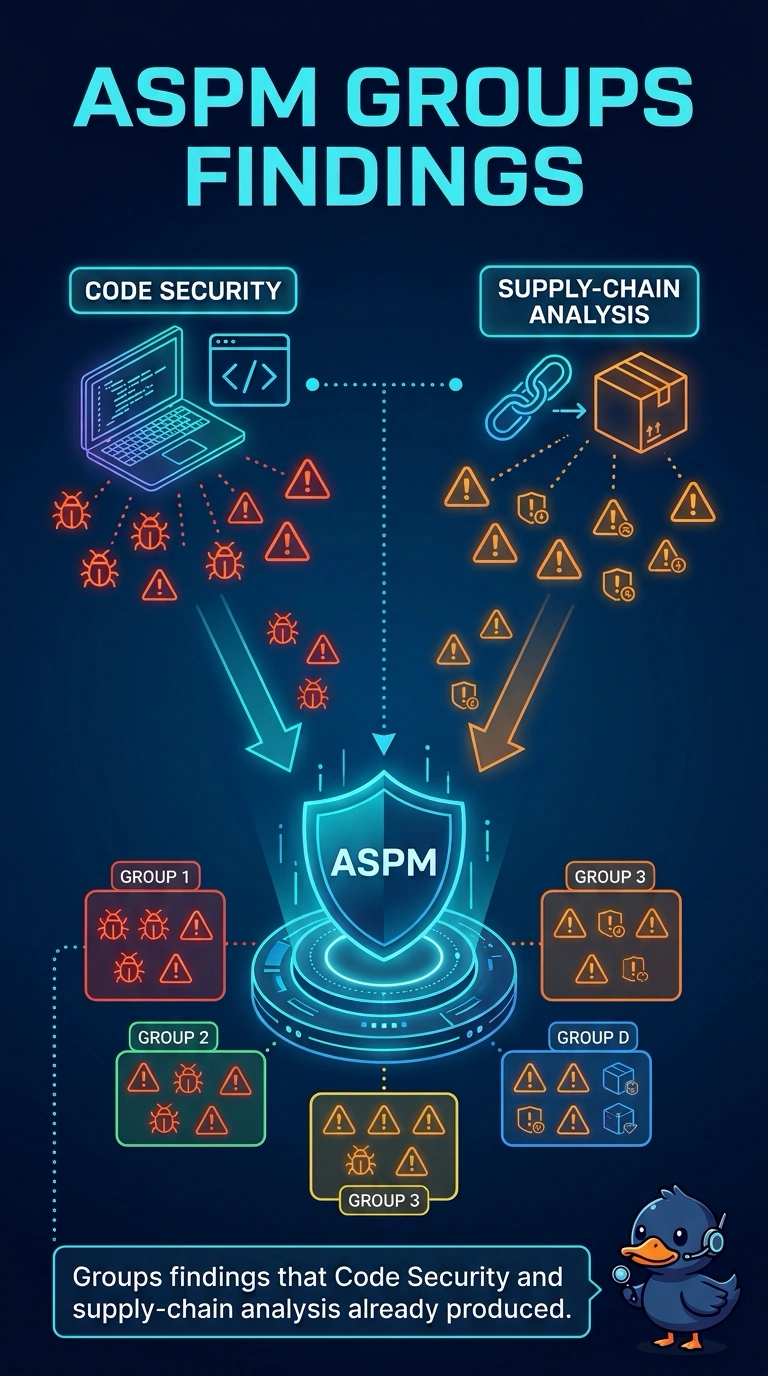
Think of ASPM as the ward clerk who files charts, not the lab that runs the tests. You want the clinic application grouped for urgency and SLAs, and ASPM does that grouping on findings other scanners already produced. Expecting ASPM to scan the repositories is the trap.
Full Explanation
ASPM does not scan. Code Security and supply-chain analysis produce the findings, and ASPM groups them onto a business application, applies urgency, and tracks issue SLAs. That grouping is what gives the clinic application's repositories, pipelines, and cloud assets one place to manage. Launching scanners and writing new findings into each repository is the scanning tier's job, not ASPM's. Replacing Code Security so ASPM itself scans secrets and dependencies contradicts that split: ASPM evaluates findings it is given, including ingested third-party results, and it does not become the scanner. Scanning the cloud account and inventing the business application from that scan skips application grouping. A cloud-account connection does not by itself define the business application. Exam caveat: a business application can be built manually or with a dynamic rule, and a bad dynamic rule will attach the wrong repositories before urgency is trustworthy. Operational check: open the clinic business application and confirm the expected repositories, pipelines, and deployed assets are members, then confirm findings on it came from a scanner that actually ran.