
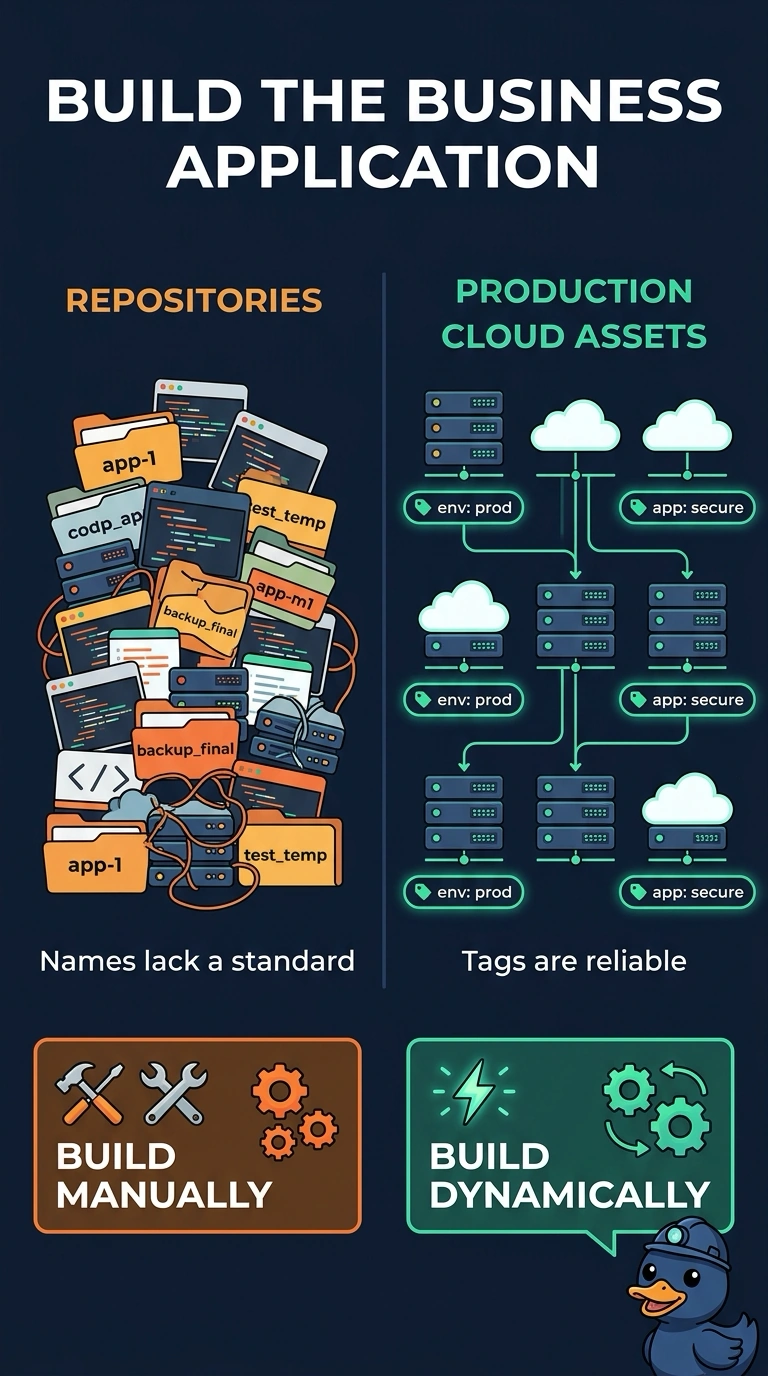
A bookstore chain's repositories follow no naming standard, while the production cloud assets carry reliable tags. How should the team build the business application in ASPM?
Select an answer to reveal the explanation.
Short Explanation
Think of a dynamic rule as a mail sorter that only works when the labels are real. You group the messy repositories by hand, and you let reliable tags build the cloud side dynamically. Trusting inconsistent names, or hoping an agent groups the application, is the trap.
Full Explanation
A business application can be assembled manually or dynamically. Manual membership is the fit when repository names do not follow a standard, because a dynamic rule on those names will attach the wrong repositories. Dynamic membership is the fit where production tags are reliable, because future assets that carry the tag join without another edit. Using only a dynamic rule on repository names the team knows are inconsistent will pull lab and production work into the same application and skew urgency. Cloud-account onboarding connects the account. It does not by itself create the business application or group repositories and pipelines. The XDR agent is runtime telemetry and prevention on a workload. It does not group repositories into an application. Exam caveat: a dynamic application rule that keys off the wrong tag still needs a fix before anyone trusts the score. Operational check: review the application members, confirm untagged or oddly named repositories were added manually, and confirm a newly tagged production asset appears without a manual edit.