
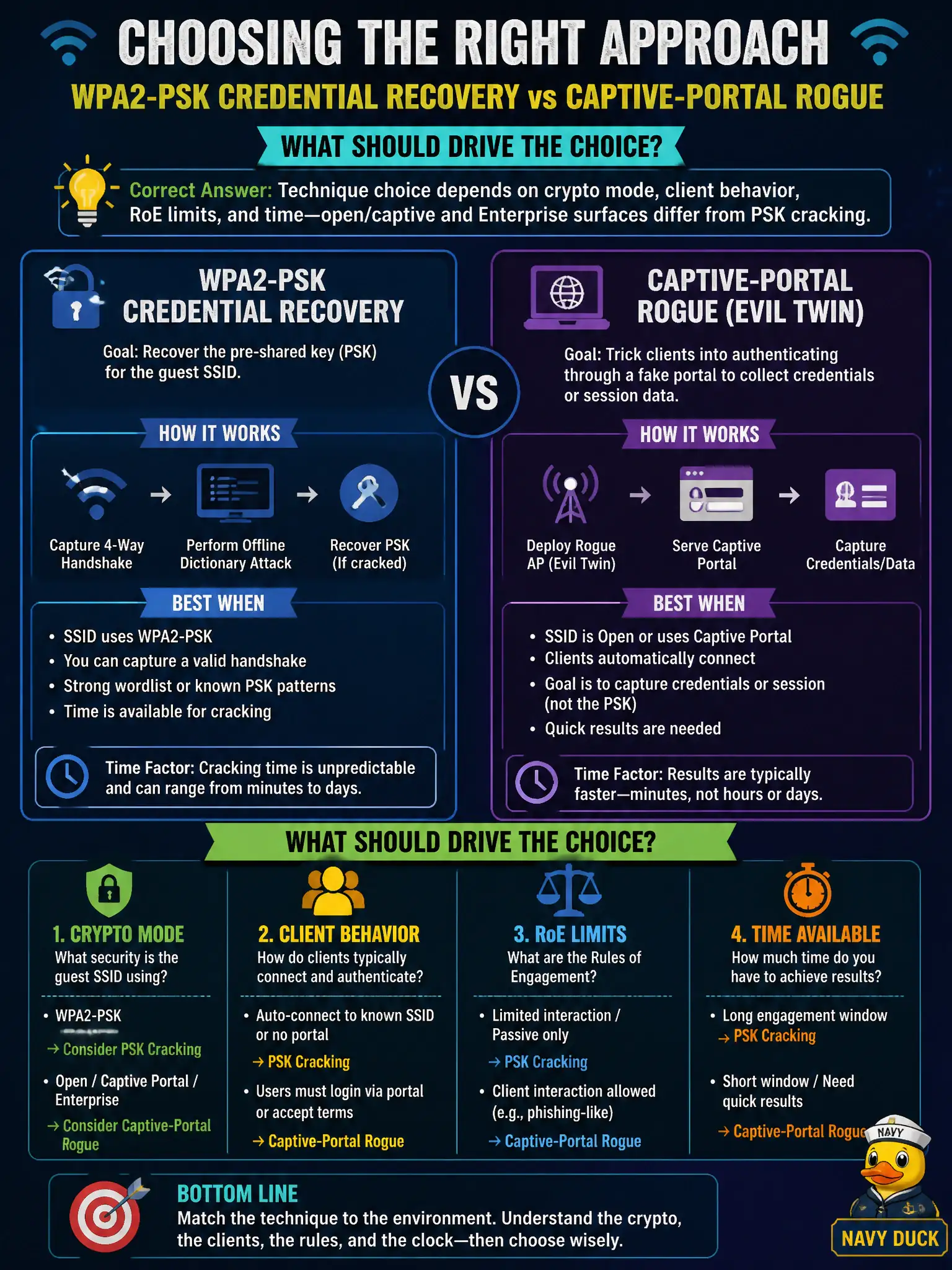
An assessor must choose between attempting WPA2-PSK credential recovery and deploying a captive-portal rogue against a conference guest SSID. What should drive the choice?
Select an answer to reveal the explanation.
Short Explanation
One size never fits Wi-Fi week. Open guest plus portal is a different animal than a PSK fortress. Match the method to the mode, the RoE, and the clock—not to your favorite lab story.
Full Explanation
Choosing between WPA2-PSK credential recovery and a captive-portal rogue against a conference guest SSID must be driven by observed crypto mode, client behavior, RoE limits, and available time. Personal PSK offline recovery classes apply when handshake or related material can be obtained under authorization; open or captive-portal guest designs often call for rogue or portal technique classes instead. Always cracking PSK first is wrong when the SSID is open or portal-gated and no PSK exists to recover. Conference SSIDs are not always WEP, and assuming legacy crypto leads to wasted effort on modern civic event networks. Captive-portal rogues are not legal only when WPS is enabled—legality and professionalism turn on authorization and scope, not WPS state. Exam caveat: Enterprise, Personal, and open or portal surfaces are not interchangeable templates, and time-boxed municipal engagements punish habit-driven tool choice. Operational check: from authorized recon, record authentication mode such as open, PSK, or 802.1X, note client density and RoE bans such as deauth or rogue limits, then pick the technique class that matches those facts within the civic engagement window. For municipal and campus engagements, keep the finding language tied to authorized scope, name the building or SSID class affected, and state the residual risk to residents or staff if the rejected option had been chosen. Re-validate after the next change window that the selected control still matches inventory, monitoring, and RoE abort criteria used by the city wireless program.