
A municipal policy bans personal hotspots that reuse or closely collide with corporate SSID names. What risk is that policy trying to reduce?
Select an answer to reveal the explanation.
Short Explanation
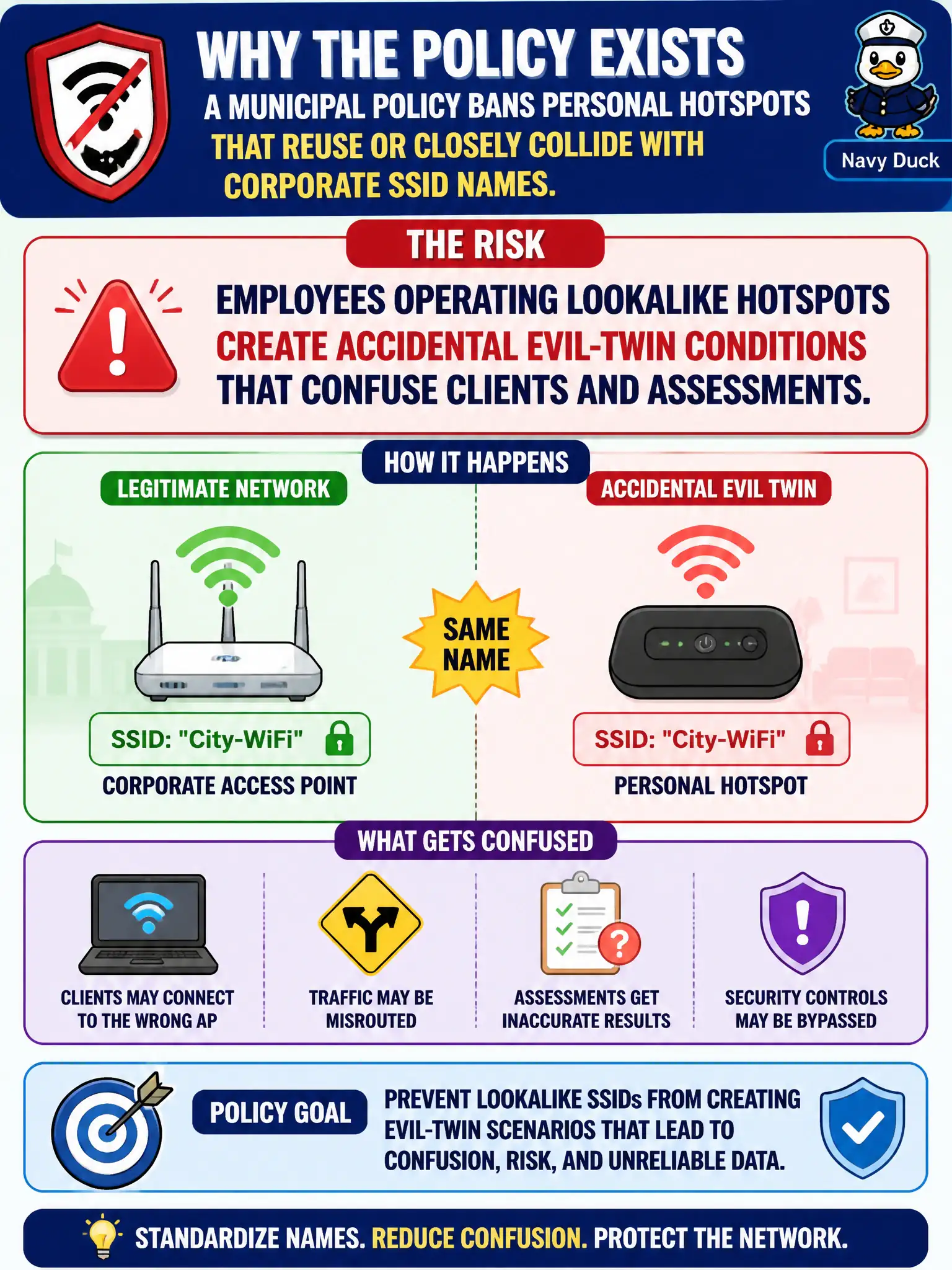
When Dave names his phone Wi-Fi after CityStaff, laptops get confused for free. That accidental twin is messy for users and for anyone hunting real rogues. Policy is just saying: stop cloning the building's nameplate.
Full Explanation
Municipal policies that ban personal hotspots reusing or closely colliding with corporate SSID names aim to reduce accidental evil-twin conditions. Employees who advertise CityStaff-like names on phone hotspots create lookalike radios that confuse client preferred-network lists, muddy WIPS and inventory workflows, and can divert devices to unmanaged upstream paths. Hotspots do not automatically upgrade clients to EAP-TLS. SSID name collision is not a Bluetooth pairing-table problem; it is an 802.11 trust and association problem inside city buildings. Corporate SSIDs remain scanable even when personal hotspots exist—the risk is confusion and mis-association, not beacon invisibility. Exam caveat: accidental twins are an operational hygiene issue distinct from malicious rogue deployment, but both abuse the same client name-matching habits. Operational check: scan civic floors for soft APs advertising corporate-like SSIDs, reconcile against authorized inventory, and enforce acceptable-use language that forbids lookalike hotspot names. For municipal and campus engagements, keep the finding language tied to authorized scope, name the building or SSID class affected, and state the residual risk to residents or staff if the rejected option had been chosen. Re-validate after the next change window that the selected control still matches inventory, monitoring, and RoE abort criteria used by the city wireless program.