
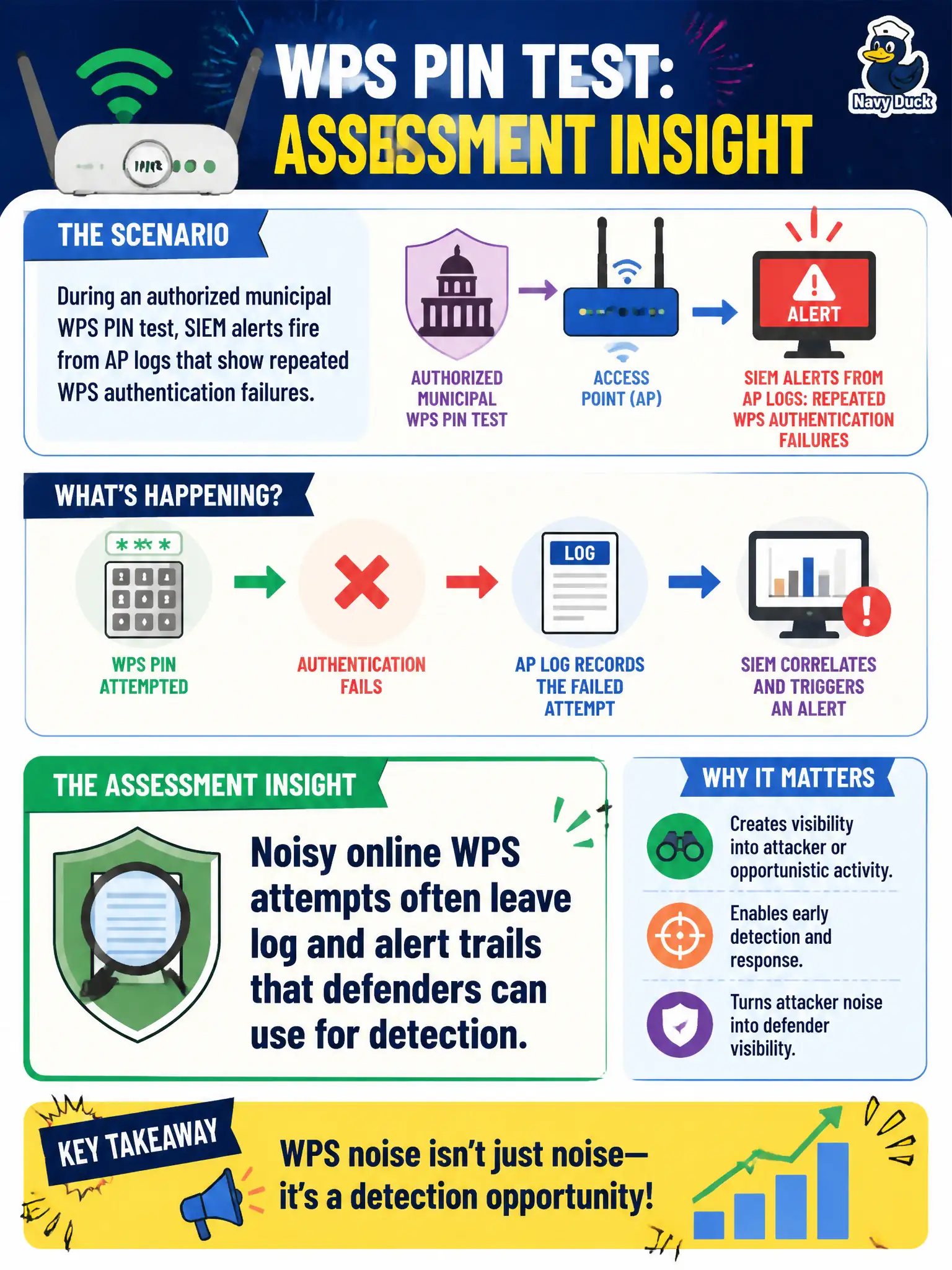
During an authorized municipal WPS PIN test, SIEM alerts fire from AP logs that show repeated WPS authentication failures. What assessment insight does that highlight?
Select an answer to reveal the explanation.
Short Explanation
Hammering WPS PINs is not a silent movie—APs complain, and SIEM hears it. That noise is both an offensive risk and a defensive gift. If the blue team is watching, online WPS is a flashlight in a dark hallway.
Full Explanation
During an authorized municipal WPS PIN assessment, repeated WPS authentication failures appearing in AP logs and SIEM alerts are an expected detectability signal, not proof of success or a claim that the technique is invisible. Online WPS PIN attempts generate failure events that many access points, controllers, and logging pipelines can surface, giving defenders usable detection use cases for wireless abuse. The correct insight is that noisy online WPS work often leaves trails that blue teams can monitor. Claiming WPS PIN attempts are invisible so SIEM alerts must be false positives misunderstands AP logging of WPS failures. Interpreting SIEM noise as proof the PIN was already recovered confuses detection of attempts with credential compromise. Assuming detection only begins after WPS is disabled reverses cause and effect—alerts fire while the feature is exercised. Exam caveat: detectability informs technique selection between online and quieter offline classes when applicable, but does not by itself change RoE. Operational check: coordinate with municipal SOC before noisy WPS windows, confirm which AP/WPS events are forwarded to SIEM, and document expected alert volume so defenders treat authorized testing as planned activity rather than an unknown incident.