
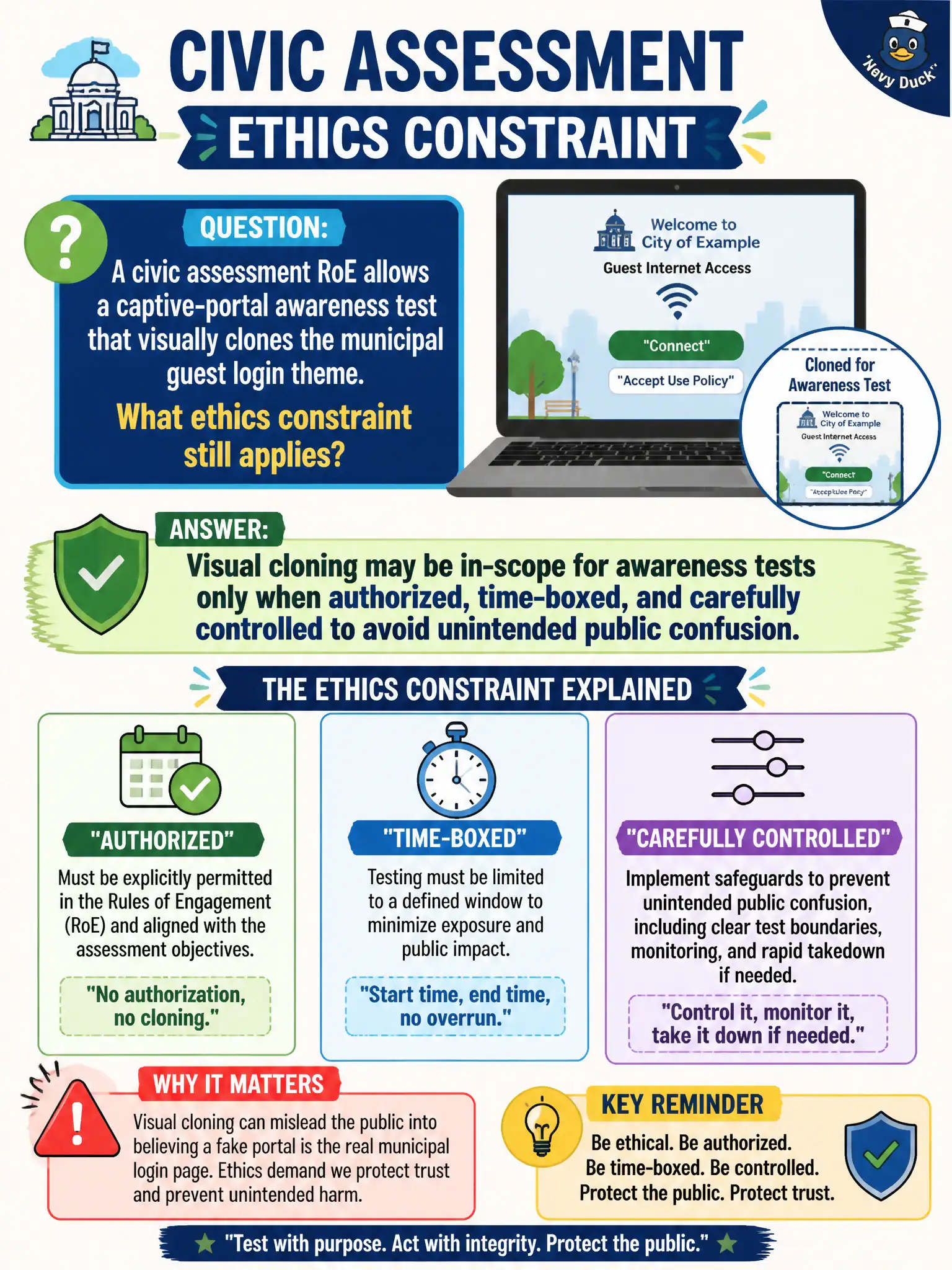
A civic assessment RoE allows a captive-portal awareness test that visually clones the municipal guest login theme. What ethics constraint still applies?
Select an answer to reveal the explanation.
Short Explanation
Looking like City Hall's guest page is powerful theater—and also how you accidentally phish half the library if nobody authorized it. Scope and control come first. If the RoE says yes, keep it short, labeled, and tightly contained.
Full Explanation
Lookalike captive portals used in civic awareness or authorized wireless assessments can be legitimate technique classes when the written rules of engagement explicitly authorize them, but authorization is only the starting gate. Visual cloning of a municipal guest login theme creates a high risk of public confusion, unintended credential submission, and fraud-like perceptions if duration, labeling, monitoring, and teardown are not tightly controlled. The correct judgment is that cloning may be in-scope only when authorized, time-boxed, and carefully supervised to prevent bystander harm. Claiming that municipal branding may never be cloned even when RoE explicitly allows a controlled lookalike ignores the difference between forbidden phishing and scoped purple-team theater. Treating any mimicry as fine merely because screenshots will later be deleted fails ethics and legal duties while the portal is live. Asserting that ethics rules do not apply because portals sit on open networks confuses Layer-2 openness with consent and engagement boundaries. Exam caveat: open guest SSIDs never waive RoE, privacy, or municipal communications constraints. Operational check: confirm written authorization for lookalike branding, define max runtime and physical/RF footprint, require clear labeling or monitoring as RoE specifies, verify teardown, and log who approved the window.