
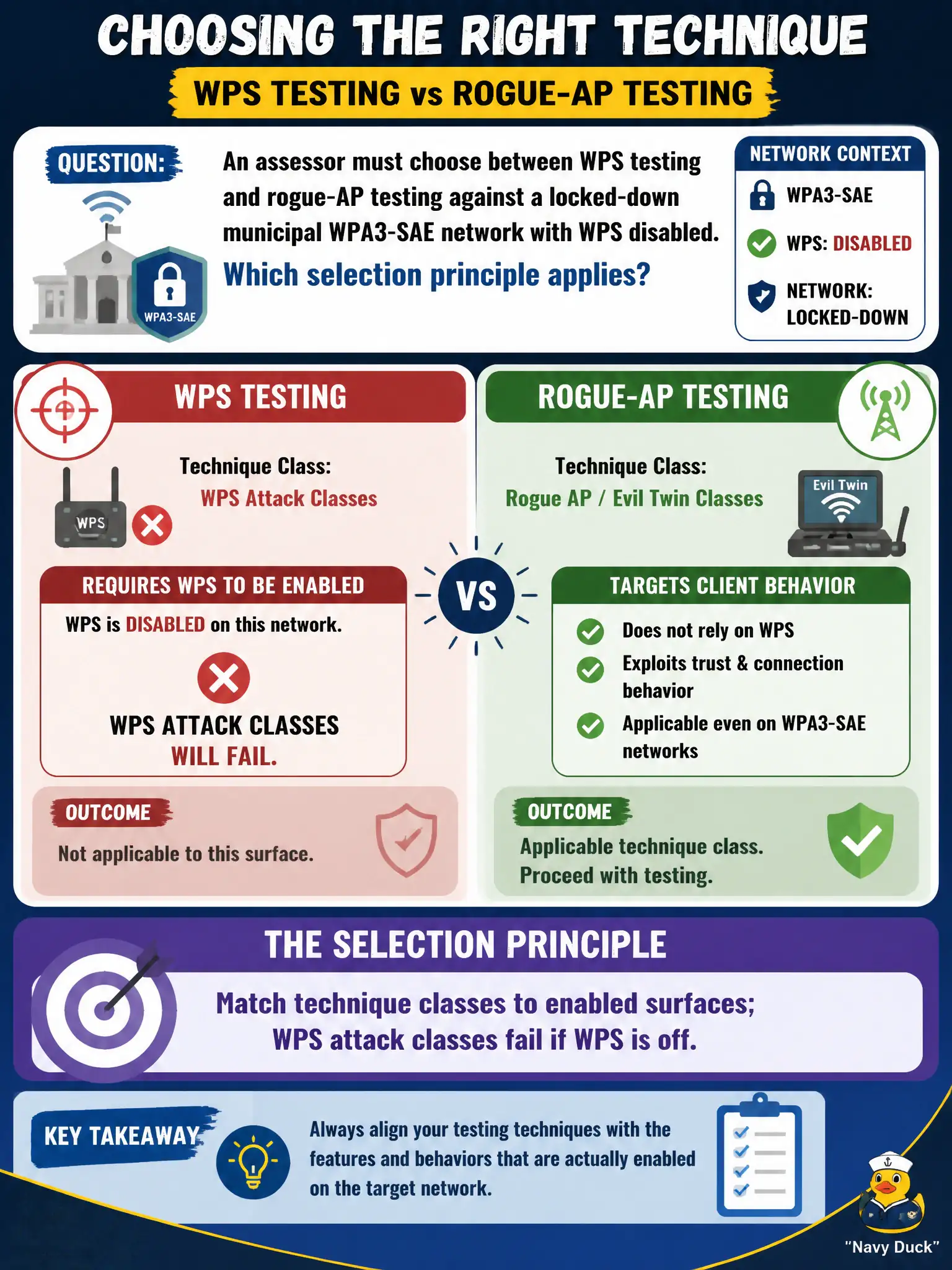
An assessor must choose between WPS testing and rogue-AP testing against a locked-down municipal WPA3-SAE network with WPS disabled. Which selection principle applies?
Select an answer to reveal the explanation.
Short Explanation
You attack what is actually turned on. WPS off means WPS techniques are a dead end—shift to surfaces that exist, like rogue/client-attraction classes if RoE allows. Do not invent WPS because SAE is there, and do not break the city's config just to keep every lab toy in play.
Full Explanation
Choosing between WPS testing and rogue-AP testing against a locked-down municipal WPA3-SAE network with WPS disabled follows a selection principle: match technique classes to enabled surfaces; WPS attack classes fail if WPS is off. Assessors should not invent surfaces by weakening the city's posture. Civic tests target what is actually present under RoE.
'Always run WPS PIN attacks first because SAE implies WPS is mandatory' fails because SAE does not imply WPS is mandatory, so always-run-WPS-first is wrong. 'Rogue-AP tests are illegal whenever WPA3 is present, so only WPS remains' fails because rogue-AP tests are not illegal whenever WPA3 is present—authorization governs, not SAE alone. 'Disable the city's SAE and re-enable WPS so every technique class stays available' fails because assessors must not disable the city's SAE and re-enable WPS just to keep every technique available.
Exam caveat: no enabled surface can still yield findings via configuration review and inventory—do not force unsafe changes. Operational check: confirm WPS-off and SAE-on via wash scan and controller policy, select allowed rogue/awareness tests if in RoE, and report positive hardening (WPS disabled) as a strength. Avoid change requests that reintroduce WPS for the assessor's convenience. In municipal wireless operations, record the rationale in the engagement notes so future assessors know which control or technique class was chosen and which failure modes the rejected options would create for city services.