
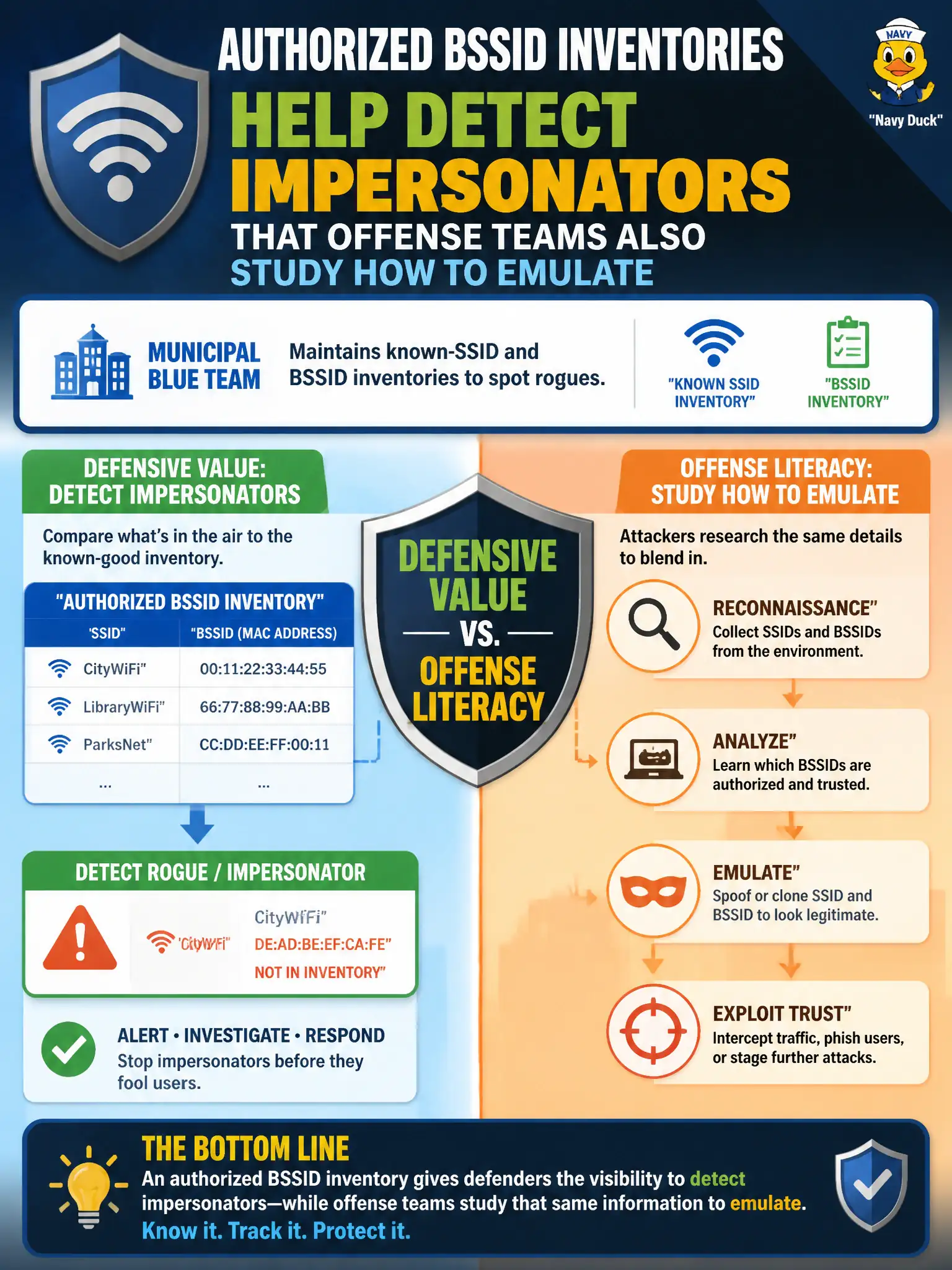
A municipal blue team maintains known-SSID and BSSID inventories to spot rogues. What defensive value does that inventory provide relative to offense literacy?
Select an answer to reveal the explanation.
Short Explanation
Know your real AP fingerprints and the lobby clone sticks out like a spare badge printer. Inventories catch impersonators; offense literacy explains how those impersonators get built. Lists do not encrypt guest Wi-Fi or crack passphrases by themselves.
Full Explanation
Municipal blue teams that maintain known-SSID and BSSID inventories gain defensive value detecting impersonators that offense teams also study how to emulate. Inventory is a detection control aligned to evil-twin literacy—not a replacement for encryption, an automatic cracker, or a spare-parts catalog. Civic SOC playbooks should alert on unknown BSSIDs advertising trusted names.
'Inventories replace the need for any encryption on guest networks' fails because inventories do not replace the need for encryption on guest networks. 'Inventories automatically crack evil-twin passphrases overnight' fails because inventories do not automatically crack evil-twin passphrases overnight. 'Inventories are useful only for ordering spare access-point brackets' fails because inventories are not useful only for ordering spare access-point brackets.
Exam caveat: stale inventories create false confidence—keep them current. Operational check: export controller BSSID lists weekly, scan for lookalike SSIDs/unknown BSSIDs in city buildings, and ticket anomalies. Share sanitized twin examples with awareness trainers without publishing attack recipes. In municipal wireless operations, record the rationale in the engagement notes so future assessors know which control or technique class was chosen and which failure modes the rejected options would create for city services.