
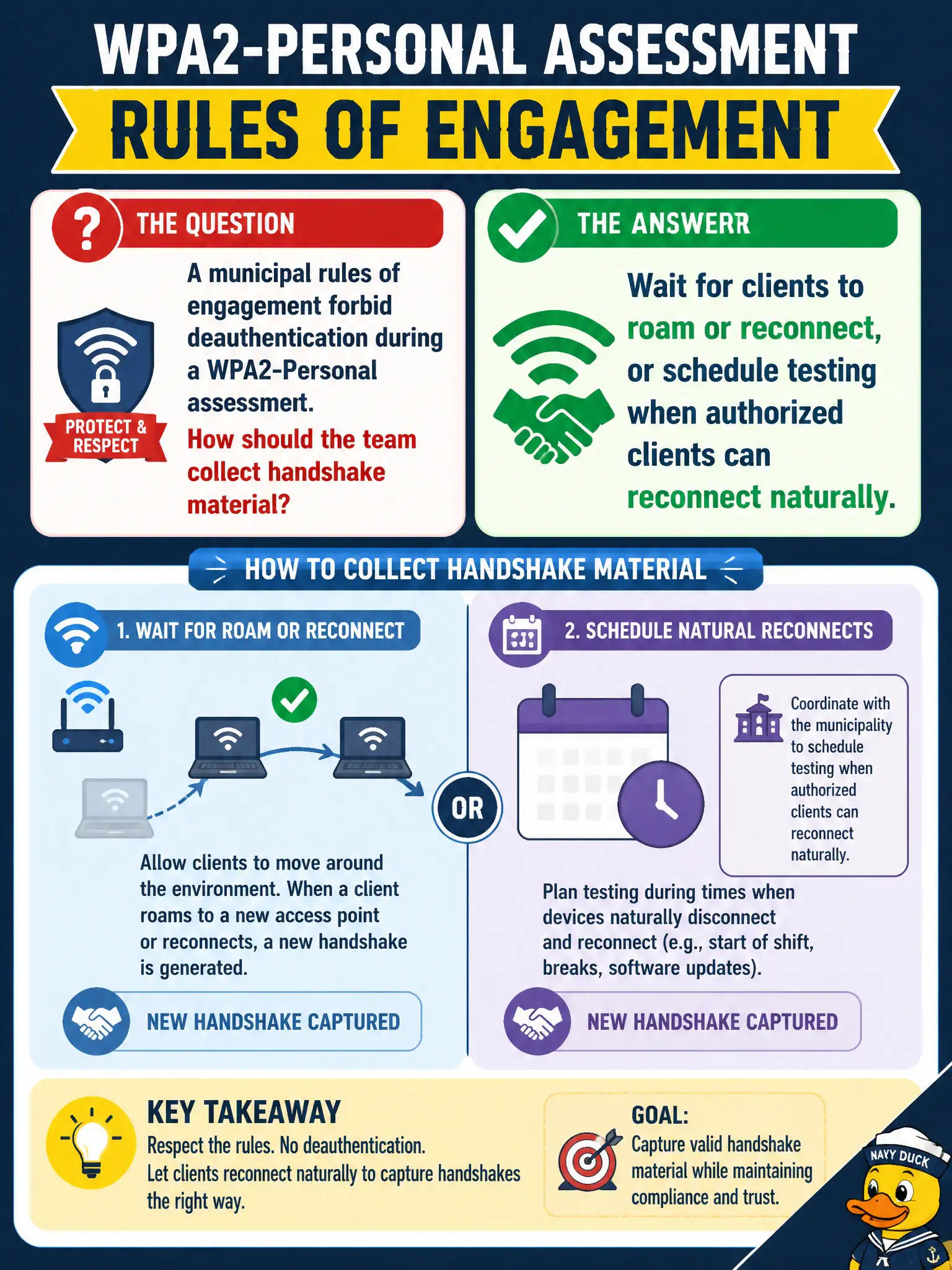
A municipal rules of engagement forbid deauthentication during a WPA2-Personal assessment. How should the team collect handshake material?
Select an answer to reveal the explanation.
Short Explanation
No-deauth RoE means patience, not improvising forced disconnects. Wait for natural reconnects or schedule a window when authorized devices can rejoin on purpose. The handshake still matters—you just collect it without kicking clients.
Full Explanation
If municipal rules of engagement forbid deauthentication during a WPA2-Personal assessment, the team should collect handshake material by waiting for clients to roam or reconnect, or by scheduling windows when authorized clients can reconnect naturally. Traffic-forcing is a technique class, not a mandatory step; civic professionalism prioritizes RoE over convenience. Natural reconnects, shift changes, and coordinated lab client joins still produce handshake opportunities without violating the engagement contract. Ignoring RoE to force reauthentication because handshake capture supposedly overrides policy is incorrect and unethical; authorization boundaries define lawful assessment. Switching to WEP IV collection until a client appears confuses deprecated WEP myths with WPA2-PSK needs and does not justify forbidden deauth. Disabling the AP radio remotely so every client must rejoin may be disruptive, out of role, and still not a license to ignore written RoE constraints on frame injection. Exam caveat: 'no deauth' does not mean 'no handshake forever'—it means adjust collection strategy and timeline. Operational check: document the RoE restriction in the city runbook, set a capture on the authorized channel/BSSID, coordinate a client reconnect with the network owner if needed, and verify EAPOL completeness before offline work. Report any schedule impacts caused by the no-deauth constraint so stakeholders understand why timing mattered.