
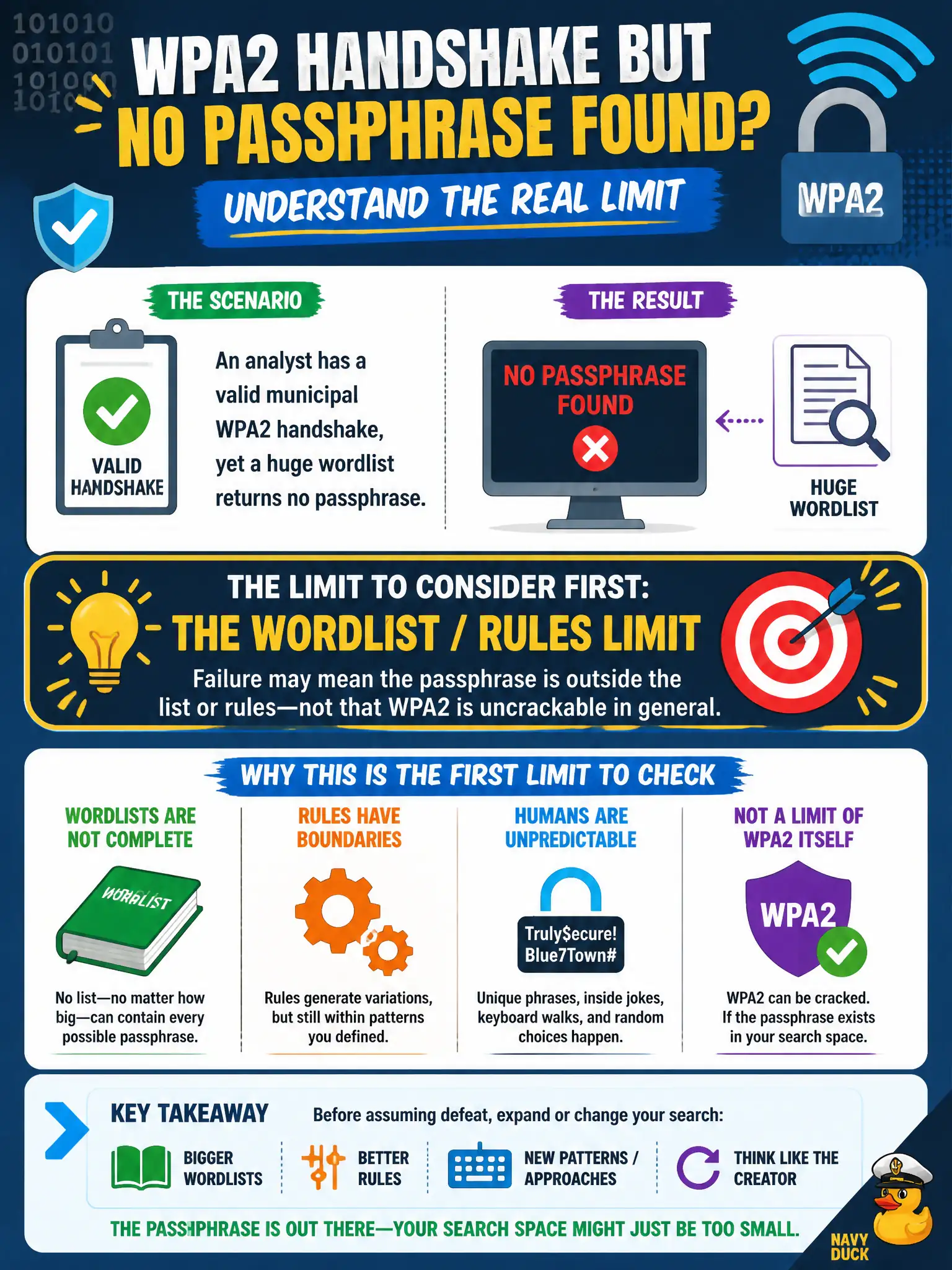
An analyst has a valid municipal WPA2 handshake, yet a huge wordlist returns no passphrase. What limit should be considered first?
Select an answer to reveal the explanation.
Short Explanation
A solid handshake plus silence from rockyou-size lists usually means the secret is not in the haystack—not that WPA2 invented unbreakable magic. Offline attacks only test what you feed them. Widen rules, retarget identity, or accept a strong PSK and pivot.
Full Explanation
A valid municipal WPA2 handshake with a huge wordlist that returns no passphrase should first be interpreted as a coverage limit: the secret may lie outside the list or rules—not as proof that WPA2 is uncrackable in general or that the capture is necessarily fake. Offline Personal recovery is a search problem over candidate space; civic assessors separate cryptographic feasibility of testing from whether this engagement's dictionary hit the actual PSK. WPA2-PSK is not cryptographically impossible to attack offline in all cases, so an empty result does not mandate that the handshake is fake. Huge wordlists do not always contain every municipal passphrase, so channel-wrong conclusions are not the automatic explanation. Empty results do not prove the AP uses Enterprise MGT when recon showed PSK; trust the observed AKM/security mode unless new evidence contradicts it. Exam caveat: verify handshake quality and target ESSID before blaming the wordlist—and verify the wordlist before blaming WPA2. Operational check: re-validate EAPOL completeness and BSSID/ESSID targeting on the city capture, test a known lab PSK control file with the same toolchain, then decide whether to expand allowed rules, accept non-recovery within the timebox, or recommend passphrase-strength findings based on policy review. Record negative results honestly in the municipal report without overclaiming impossibility.