
A student aims aircrack at the wrong ESSID inside a multi-SSID municipal capture. What process lesson applies?
Select an answer to reveal the explanation.
Short Explanation
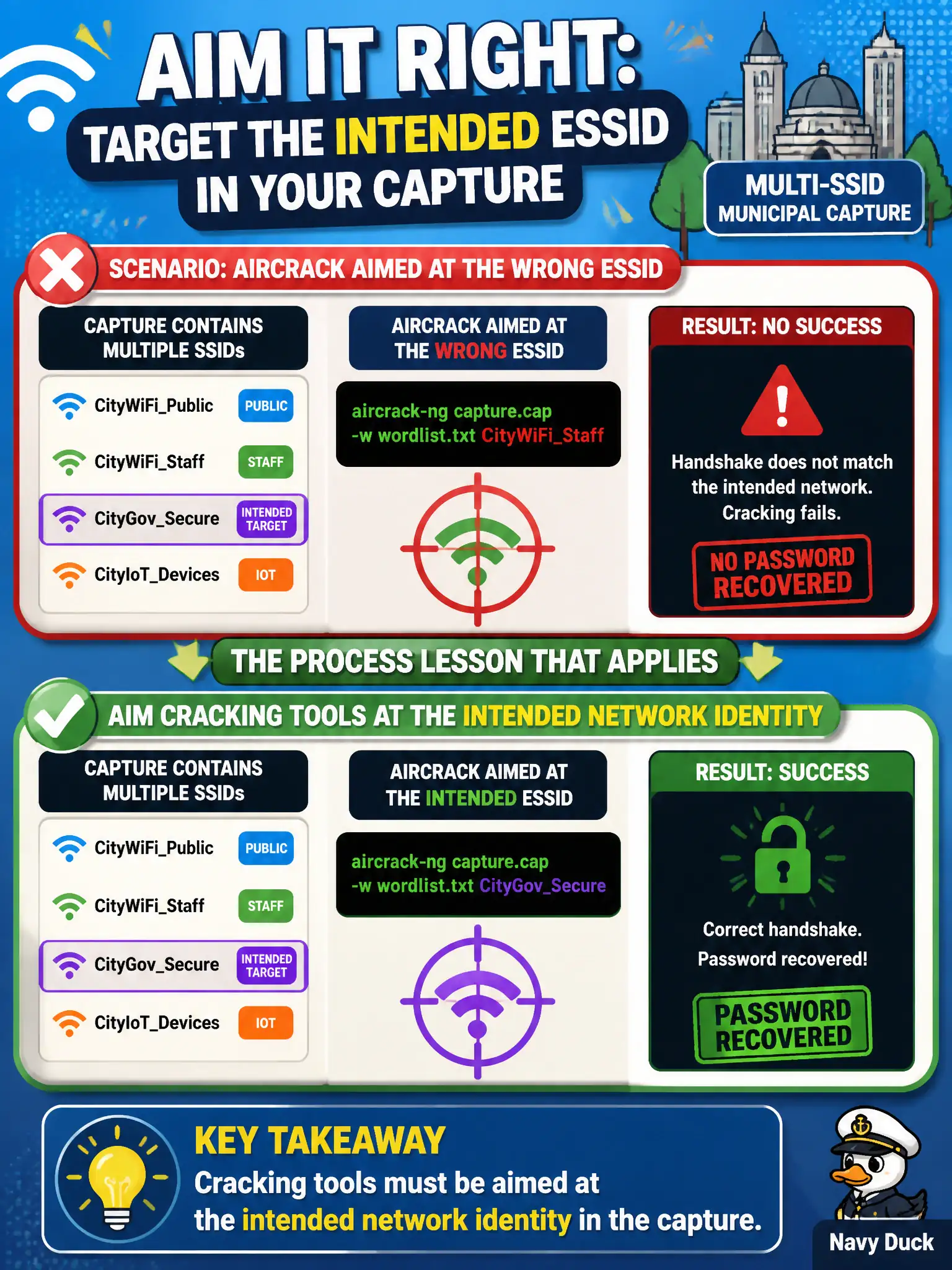
Multi-SSID captures are like a folder of different office locks—pick the wrong label and you polish the wrong key. Point the cracker at the authorized ESSID/BSSID you actually scoped. Target selection is part of the process, not trivia.
Full Explanation
When a student aims aircrack at the wrong ESSID inside a multi-SSID municipal capture, the process lesson is targeting discipline: cracking tools must be aimed at the intended network identity in the capture. Shared channels and busy civic airspace often place multiple Personal networks in one file; selecting the wrong ESSID/BSSID wastes time on out-of-scope or irrelevant material and can produce misleading 'no key found' conclusions about the authorized target. Any ESSID in the file does not work because Personal networks do not share one global PMK; PMK material is bound to the passphrase and SSID context for that network. Wrong ESSID selection is not a WEP-only concern; WPA2-PSK offline attempts equally require the correct network identity. Tools do not automatically retarget the strongest BSSID as a cosmetic choice; operators must specify or select the authorized target deliberately. Exam caveat: strongest signal is not the same as in-scope target—RoE and inventory beat RSSI heuristics. Operational check: before launching the civic cracker job, list ESSIDs/BSSIDs in the capture, match the engagement inventory, pass the correct identity into the tool, and annotate the chosen BSSID in notes. If results are empty, re-verify target selection before concluding the municipal passphrase is outside the wordlist.