
An assessor evaluating a municipal WPA2-Personal capture considers adding John the Ripper to the toolchain. What purpose class does John the Ripper fill here?
Select an answer to reveal the explanation.
Short Explanation
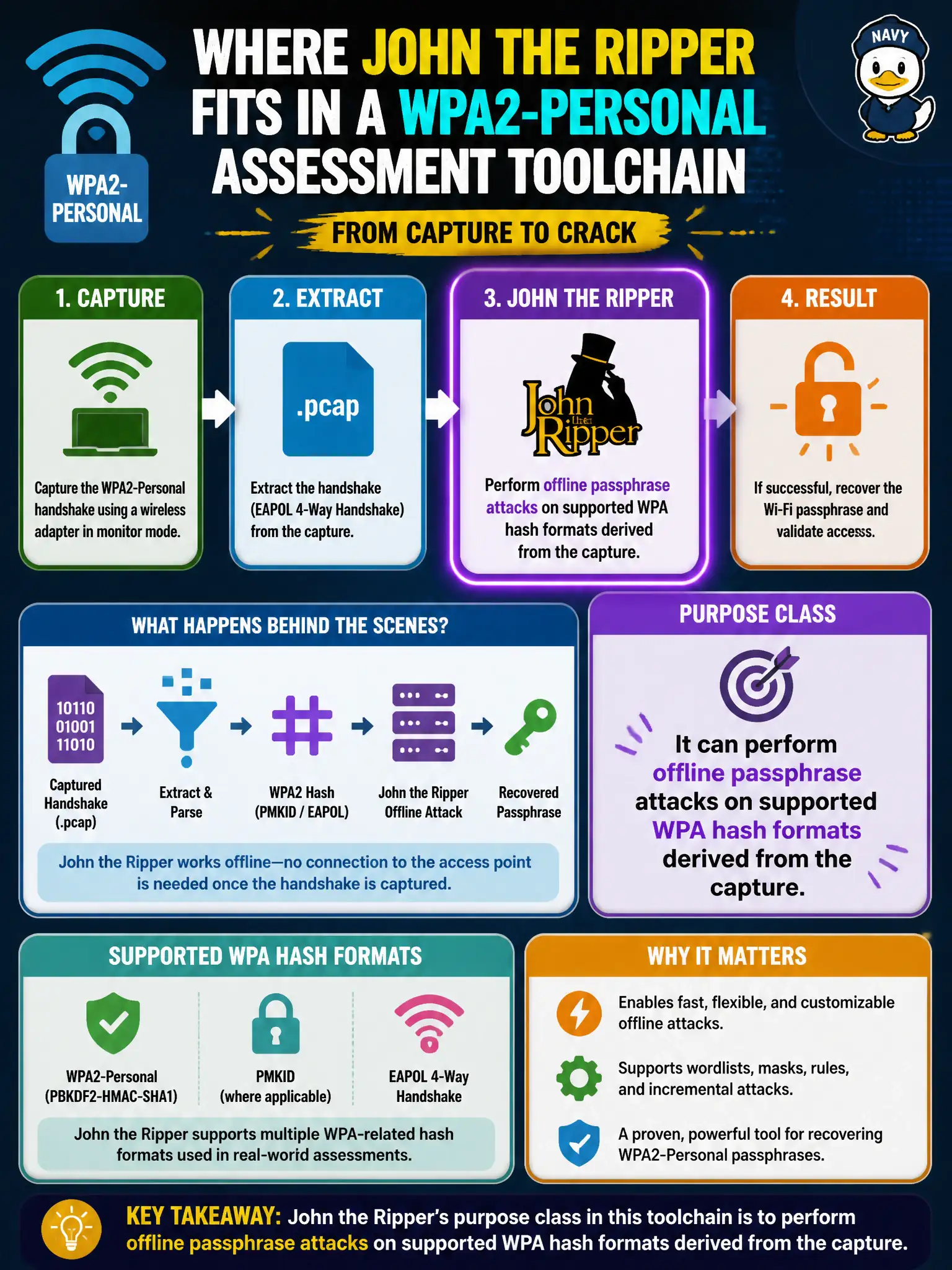
John the Ripper is another offline guesser sitting next to the capture—like trying keys on a lock you already photographed, not kicking doors on the live AP. Feed it a supported WPA hash format and it works the passphrase candidates locally. It is not the monitor-mode or deauth tool.
Full Explanation
John the Ripper fills the offline passphrase-recovery tool class for municipal WPA2-Personal assessments: after an authorized capture is converted into a supported WPA hash representation, John can apply dictionaries and rules against that material on the assessor's machine. It sits conceptually beside aircrack-ng and hashcat as another offline guesser, not as a live RF control utility. City assessors add it when format support, rules, or workflow preference favor John—not because it replaces monitor-mode setup or access-point configuration. It does not replace airmon-ng for placing a wireless interface into monitor mode; interface preparation remains a separate Linux wireless toolchain step. It does not forge deauthentication frames to force clients to rejoin a municipal SSID; management-frame injection belongs to other tool purposes and must follow rules of engagement. It does not provision WPA3-SAE credentials onto the access point; AP security mode and SAE onboarding are configuration and protocol concerns outside John's cracking role. Exam caveat: unsupported or incomplete hash conversion yields useless runs even when John is installed, and offline success still depends on wordlist coverage. Operational check: on the authorized civic capture, confirm handshake completeness, export the correct hash format, run a short known-passphrase sanity crack with John, then proceed to engagement wordlists while storing outputs under the city's evidence handling rules. Note in the report that John was used as an offline recovery option after capture—not as the monitor-mode or deauth mechanism.