
A city wireless assessment team compares recovering a WPA2-PSK passphrase with aircrack-ng on CPU versus hashcat on a GPU lab box. At judgment level, what difference matters most?
Select an answer to reveal the explanation.
Short Explanation
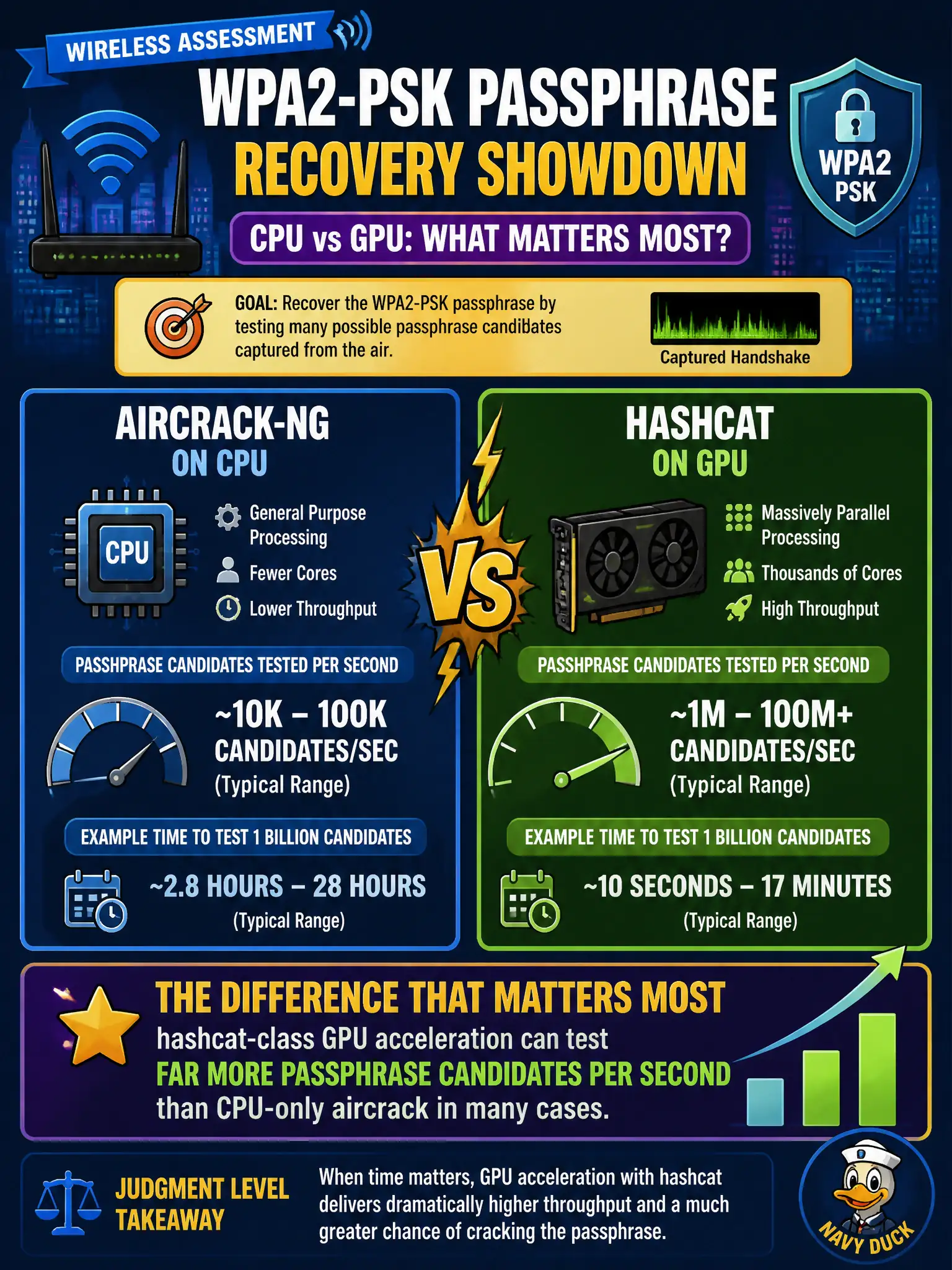
Think of the wordlist as a giant phone book and the GPU as a warehouse of clerks flipping pages at once. Aircrack on a plain CPU still works, but hashcat on GPU usually burns through candidates much faster. Speed is the judgment call—not a different crypto magic.
Full Explanation
For authorized municipal WPA2-PSK recovery work, the judgment difference between CPU-bound aircrack-ng and hashcat-class GPU cracking is throughput: GPU acceleration can test far more passphrase candidates per second against the same handshake or hash material in many lab setups. Both tool classes still perform offline dictionary or rule-based guessing against captured Personal-network material; neither invents a new cipher break. The civic assessment team should therefore treat GPU versus CPU as a workflow and capacity choice after a complete, correctly scoped capture exists—not as proof that one path alone is cryptographically valid. CPU-only aircrack does not always recover any passphrase faster merely because it stays closer to the capture file; proximity of the process to the .cap does not outweigh candidate rate when the secret is nontrivial. Claiming hashcat cannot use WPA handshake material is incorrect: maintained GPU crackers routinely accept converted WPA/WPA2 PSK hashes derived from handshakes or related formats. Restricting GPU cracking to WEP IVs confuses deprecated IV accumulation myths with modern Personal offline attacks, which center on handshake or PMKID-class material rather than WEP keystream recovery. Exam caveat: faster guessing still fails if the wordlist and rules never cover the passphrase, and WPA3-SAE is not the same offline path as WPA2-PSK. Operational check: in the city lab, convert the authorized capture to the cracker's expected format, run a timed GPU versus CPU pilot on a known test PSK, record guesses-per-second, and keep RoE-scoped wordlists only on assessor-controlled systems. Document the throughput rationale in the municipal engagement notes so future assessors reuse the same capacity judgment rather than assuming tool brand alone guarantees recovery.