
A county security lead asks why weak Wi-Fi passphrases often fall after a WPA2-Personal handshake is obtained in an authorized assessment. What is the core reason?
Select an answer to reveal the explanation.
Short Explanation
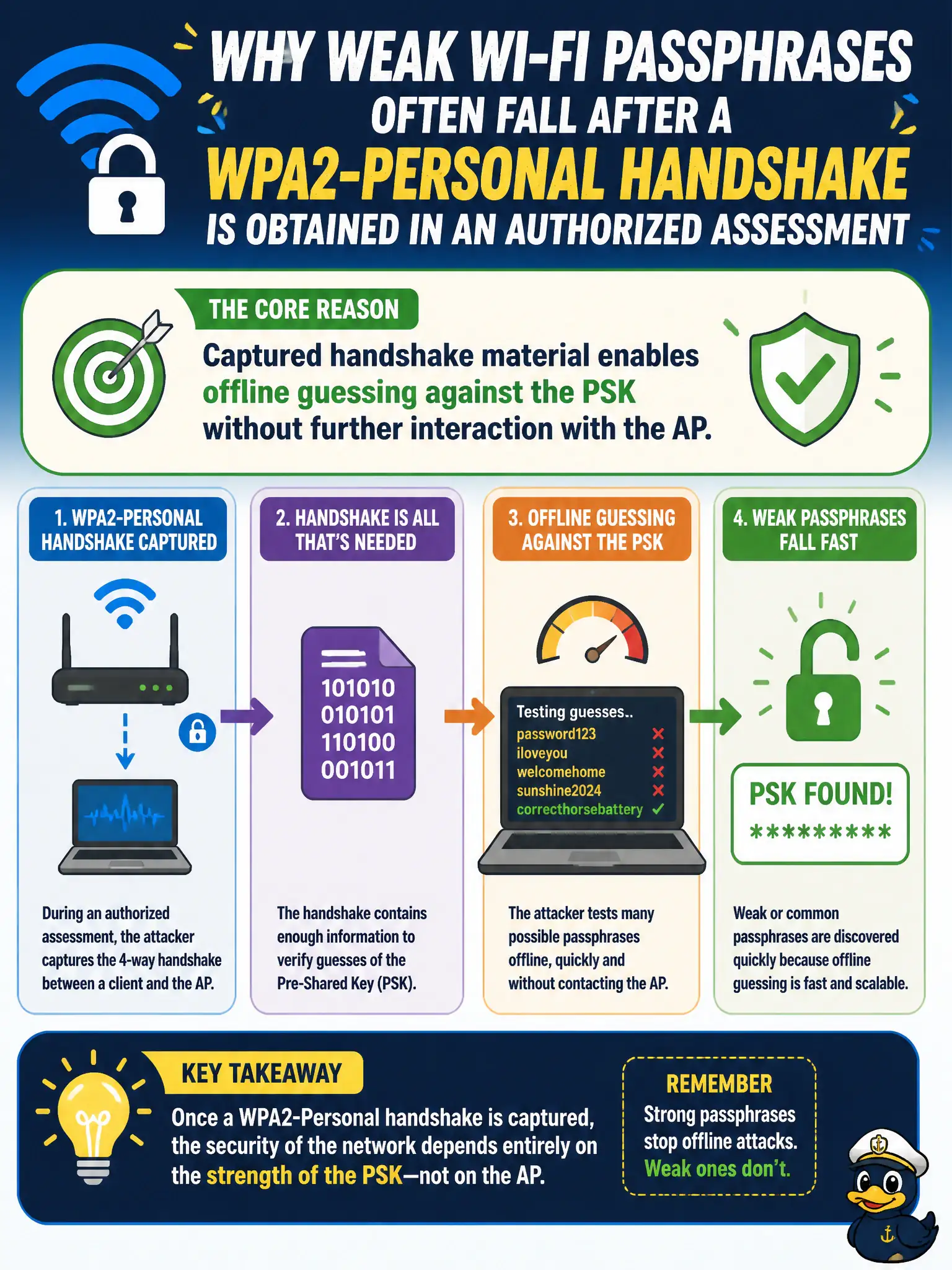
Once you have a solid handshake under RoE, the guessing moves to your own hardware—no need to keep poking the AP for each try. Weak passphrases fold under that offline dictionary-class pressure. Strong, unique passphrases are how counties survive that step.
Full Explanation
Weak Wi-Fi passphrases often fall after a WPA2-Personal handshake is obtained because the captured handshake material enables offline guessing against the PSK without further interaction with the AP. Each candidate can be checked on the assessor’s hardware against the EAPOL transcript, so poor entropy collapses under dictionary or brute-force pressure during an authorized county assessment. Strong passphrases remain expensive to guess even with a perfect handshake. Saying the handshake disables encryption so all data frames become readable without guessing fails by concept: the handshake sets up keys; it does not turn the BSS into cleartext by itself. Claiming weak passphrases are printed in cleartext inside every beacon after the first EAPOL message fails by concept: beacons do not publish the PSK in cleartext that way. Asserting handshake capture automatically upgrades the AP to WEP for easier live brute force fails by concept: capturing EAPOL does not downgrade the AP to WEP. Exam caveat: offline success against a weak PSK proves passphrase policy failure—remediate with strong unique PSKs or Enterprise/SAE designs; do not treat capture alone as full network compromise without the guessing step. Operational check: after authorized handshake capture, run offline testing with approved wordlists, record time-to-crack or failure, demonstrate impact only within RoE (for example controlled association), and recommend civic passphrase or architecture hardening in the final report.