
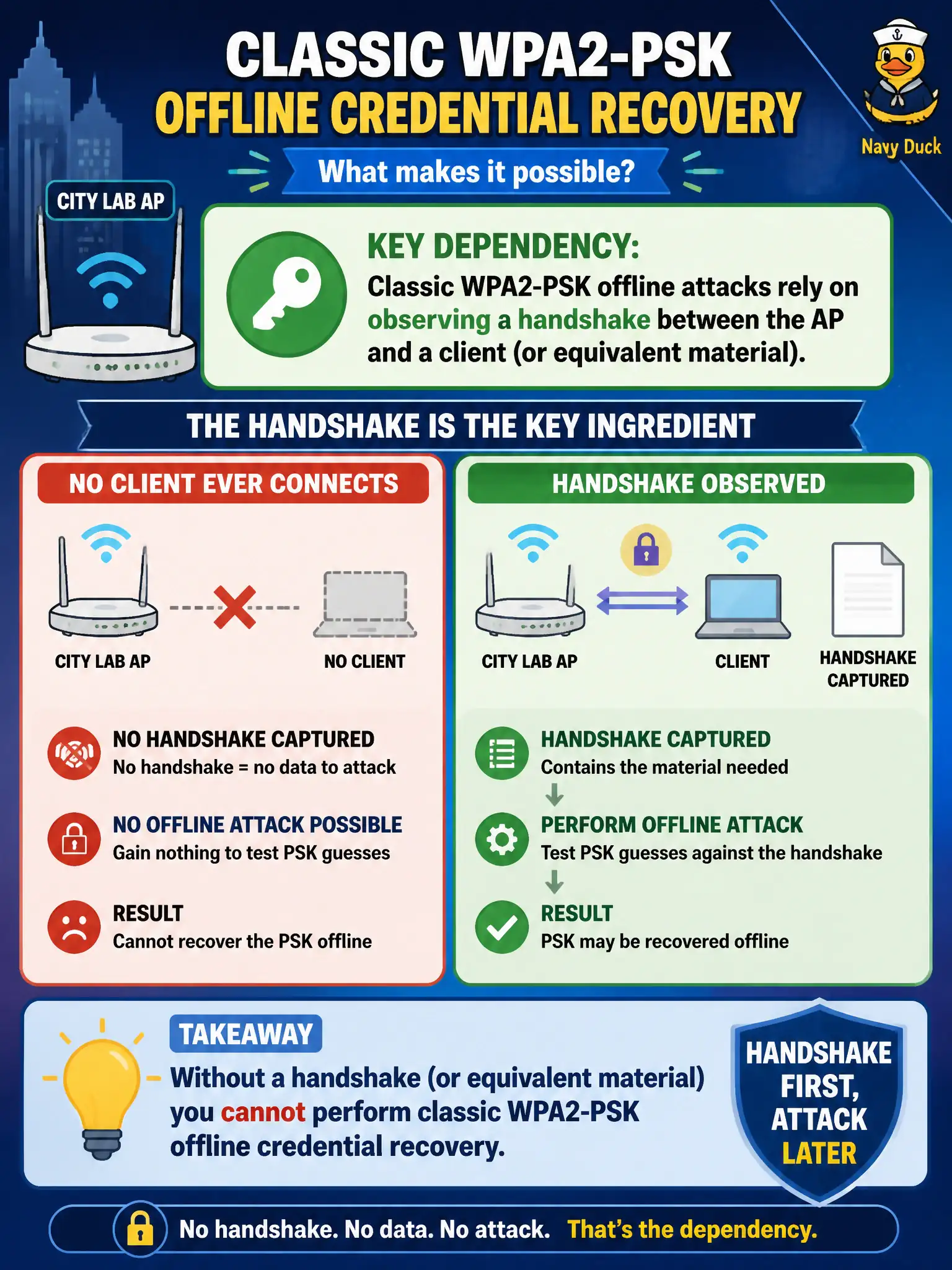
A student wants to perform classic WPA2-PSK offline credential recovery without any client ever connecting to the city lab AP. What dependency should the instructor emphasize?
Select an answer to reveal the explanation.
Short Explanation
No client, no handshake dance—and classic offline PSK work sits on that dance. Waiting for or authorizing a client connection is part of the method class. Staring at beacons with zero stations will not invent the missing exchange.
Full Explanation
Classic WPA2-PSK offline credential recovery depends on observing a handshake between the AP and a client (or equivalent key-exchange material). Without client participation that produces EAPOL, the assessor lacks the cryptographic transcript against which passphrase candidates are checked. Instructors should emphasize that monitor mode and SSID knowledge alone do not remove the handshake dependency in the classic model. Saying offline attacks need only the SSID string printed on the AP sticker fails by concept: the SSID is an input to PSK derivation but not a substitute for handshake transcripts. Claiming beacon frames alone always contain enough PMK material to finish offline guessing fails by concept: beacons do not hand the assessor a ready PMK for guessing completion in that way. Asserting client activity is irrelevant if monitor mode is enabled on any channel fails by concept: wrong channel plus no handshake still yields nothing usable. Exam caveat: some modern modes and PMKID-related techniques appear in tooling discussions—still verify what the specific municipal lab and exam objectives require rather than assuming every shortcut applies. Operational check: ensure at least one authorized client can connect to the lab AP, capture a complete handshake on the correct channel, then run offline recovery; if no client exists, arrange a lab station rather than pretending beacons suffice.