
A municipal RoE allows a brief deauthentication in a lab to force reauthentication on a WPA2-Personal SSID. What is the purpose of that action class?
Select an answer to reveal the explanation.
Short Explanation
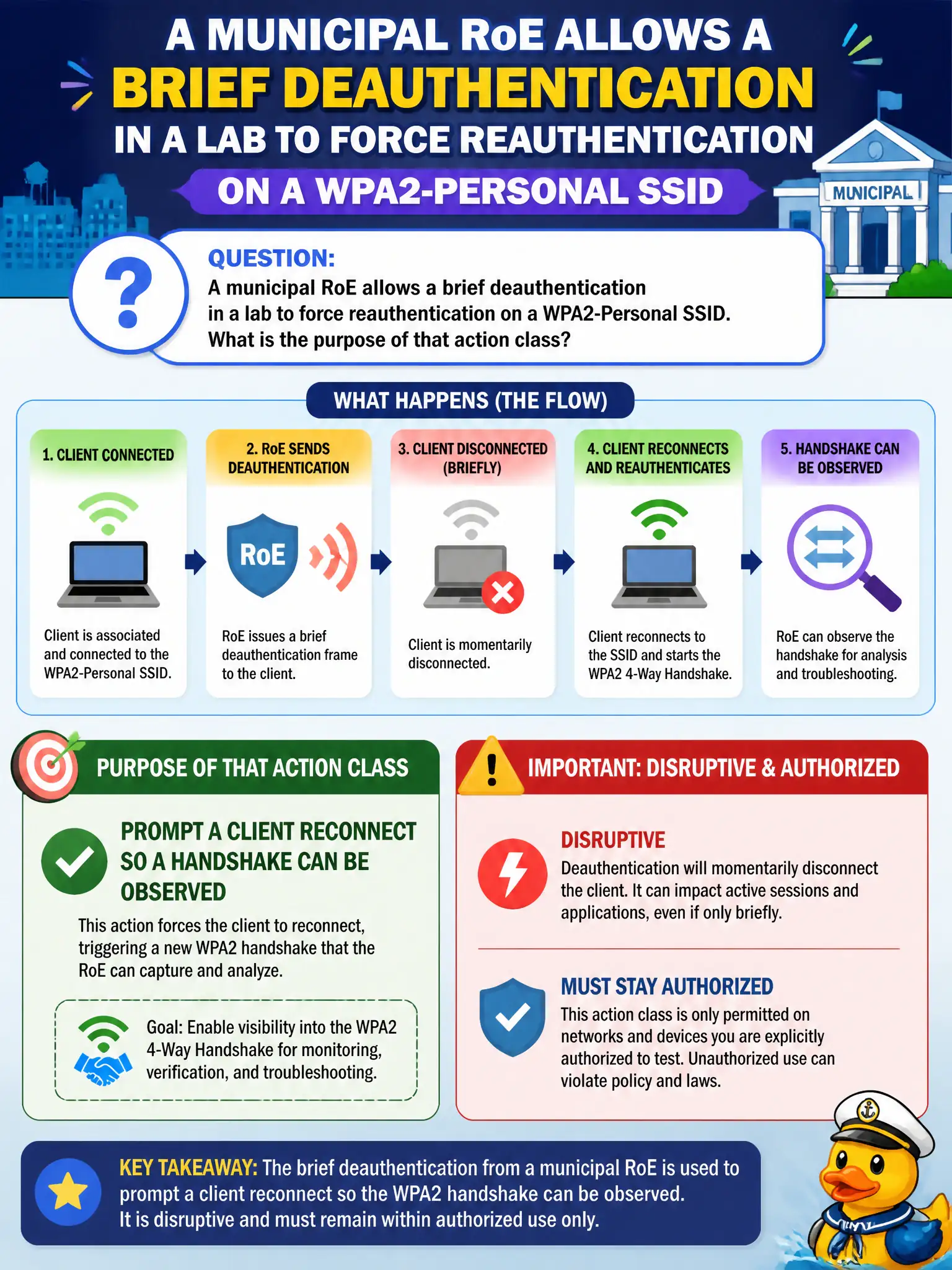
A short, authorized deauth is a polite shove: the client reconnects and the handshake shows up for capture. It knocks users briefly—so RoE has to bless it. It is not an AP brick button or a crypto downgrade spell.
Full Explanation
When municipal RoE allows a brief deauthentication in a lab to force reauthentication on a WPA2-Personal SSID, the purpose of that action class is to prompt a client reconnect so a handshake can be observed. It is inherently disruptive to the targeted client session and must remain explicitly authorized, short, and aimed only at in-scope stations. Civic labs use it as a controlled stimulus, not as a DoS hobby. Saying deauth permanently disables the AP radio until physical power is removed fails by concept: deauth targets stations’ association state; it is not an AP power-off. Claiming it converts WPA2-Personal into open authentication without a reboot fails by concept: deauth does not downgrade the BSS cipher suite to open. Asserting it replaces monitor-mode capture by forging DHCP acknowledgments only fails by concept: handshake capture still needs RF monitor evidence; DHCP forgeries are a different technique class. Exam caveat: production civic SSIDs may forbid deauth even if lab SSIDs allow it—never carry lab habits into live networks without reading the RoE phase. Operational check: confirm written deauth permission, identify a single in-scope client, send a minimal authorized deauth while capturing on-channel, verify EAPOL completeness, and stop transmitting immediately after the handshake is obtained.