
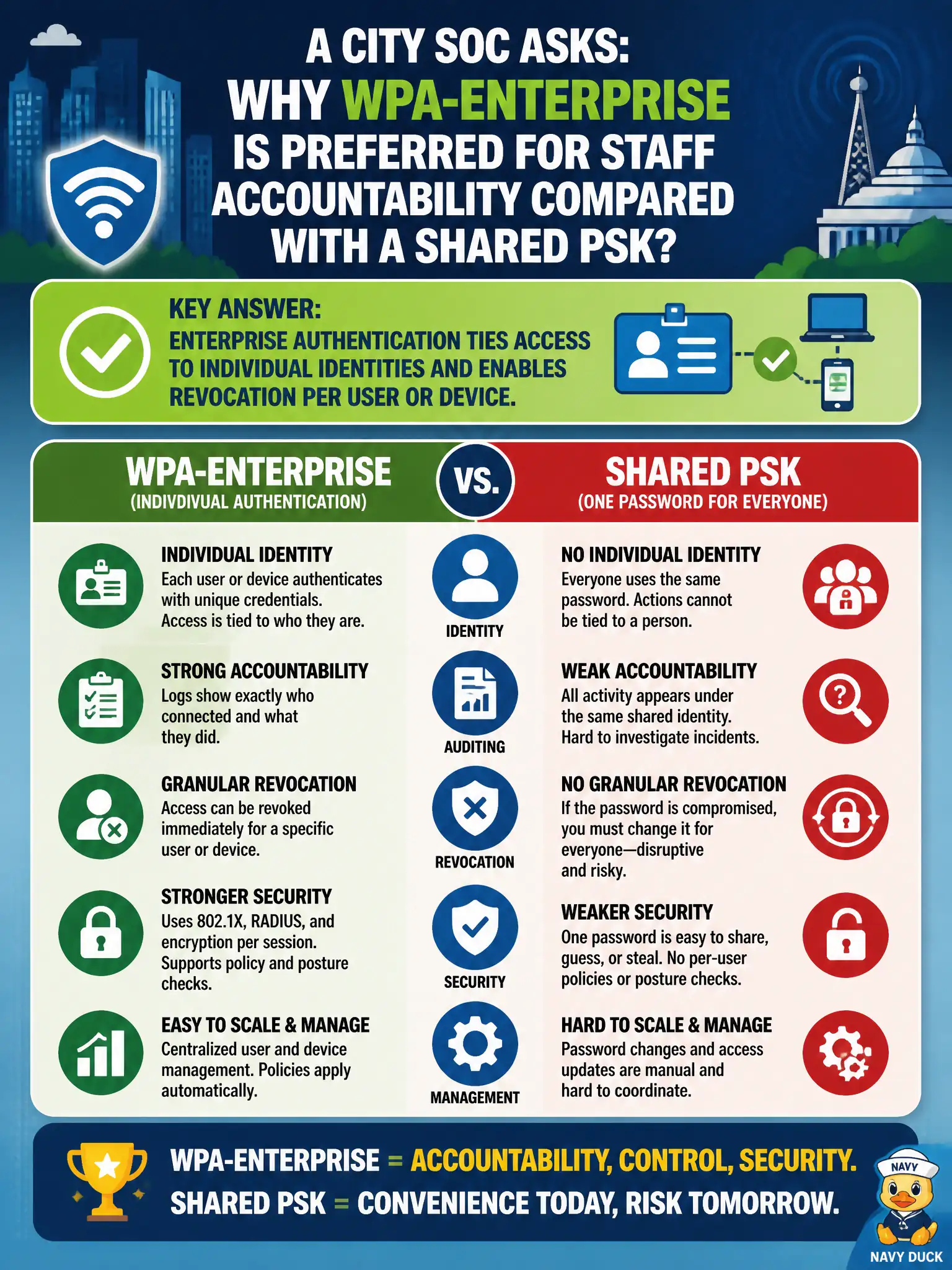
A city SOC asks why WPA-Enterprise is preferred for staff accountability compared with a shared PSK. What benefits should the brief highlight?
Select an answer to reveal the explanation.
Short Explanation
A shared PSK is one house key for the whole department. Enterprise hands each person or device its own badge you can revoke. That is the accountability win—not 'no encryption' or jamming rights.
Full Explanation
WPA-Enterprise is preferred for staff accountability compared with a shared PSK because Enterprise authentication ties access to individual identities and enables revocation per user or device without rotating a building-wide passphrase. Enterprise does not remove the need for encryption after association on municipal SSIDs. Enterprise does not make RF jamming legal inside city limits. Enterprise does not automatically disable all guest networks without VLAN planning. Exam caveat: accountability benefits require working AAA, logging, and joiner-mover-leaver processes; a mis-shared PEAP password can still weaken the model. Operational check: show civic stakeholders how disabling one account removes WLAN access, contrast that with PSK rotation pain, and verify RADIUS accounting feeds identity-aware monitoring where required. For municipal and campus engagements, keep the finding language tied to authorized scope, name the building or SSID class affected, and state the residual risk to residents or staff if the rejected option had been chosen. Re-validate after the next change window that the selected control still matches inventory, monitoring, and RoE abort criteria used by the city wireless program.